


Elite health does not exist without regularity.
Live with a consistently timed system and your bodily rhythms stay synced.
Live without one and your metabolism starts to fail you.
And the metabolic effect isn’t insignificant.
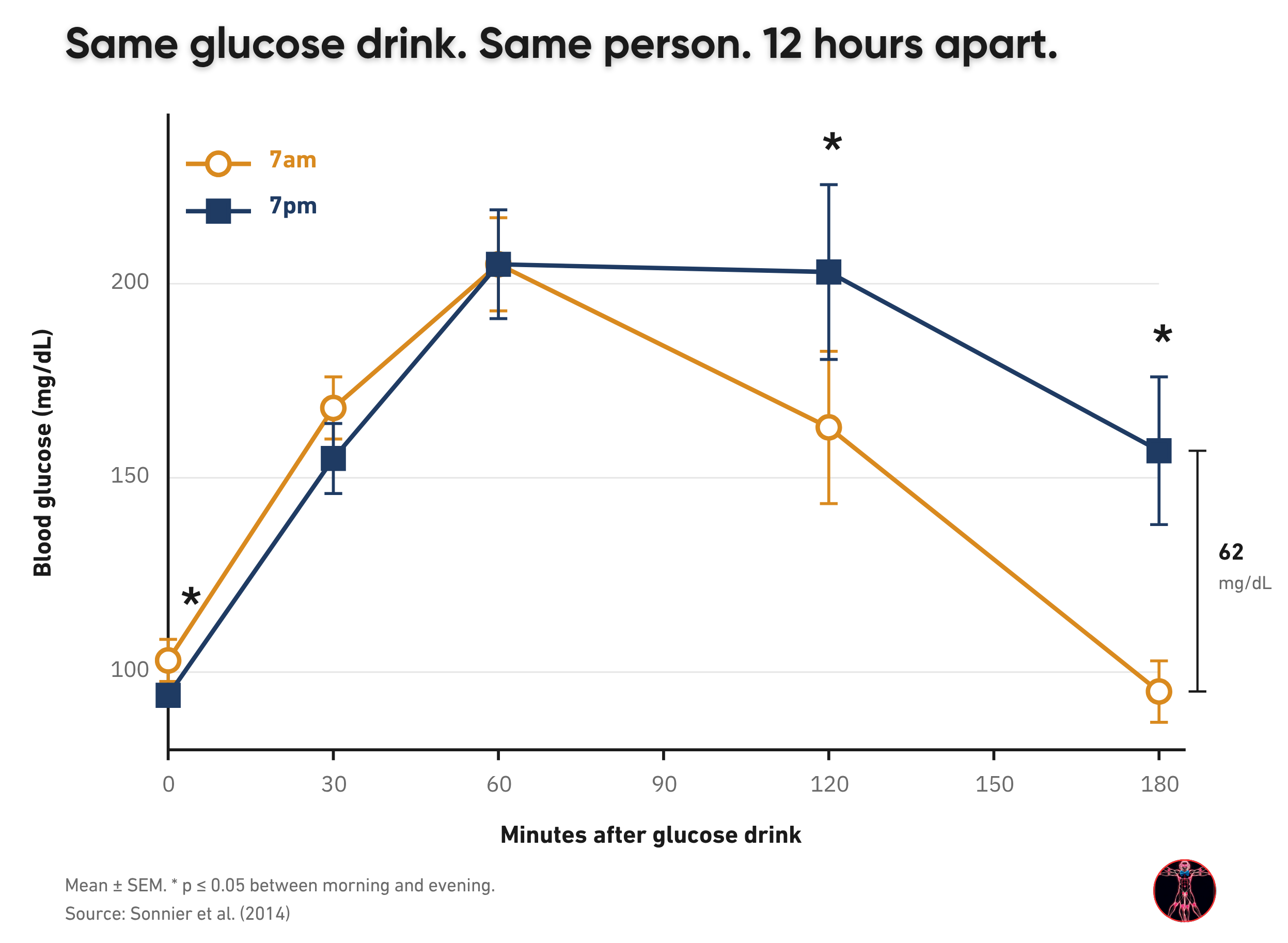
An identical 75 g carb drink raised 3-hour blood sugar levels 62 mg/dL higher at 7 PM than at 7 AM. The same person drank the same drink on the same day with a wildly different metabolic response.
The circadian–metabolic connection is real. And the highest ROI levers that control it are non-negotiable for dialing in cardiometabolic health.
Here are 9 of the best (& completely free) ones you can implement today.
1) Get bright light early
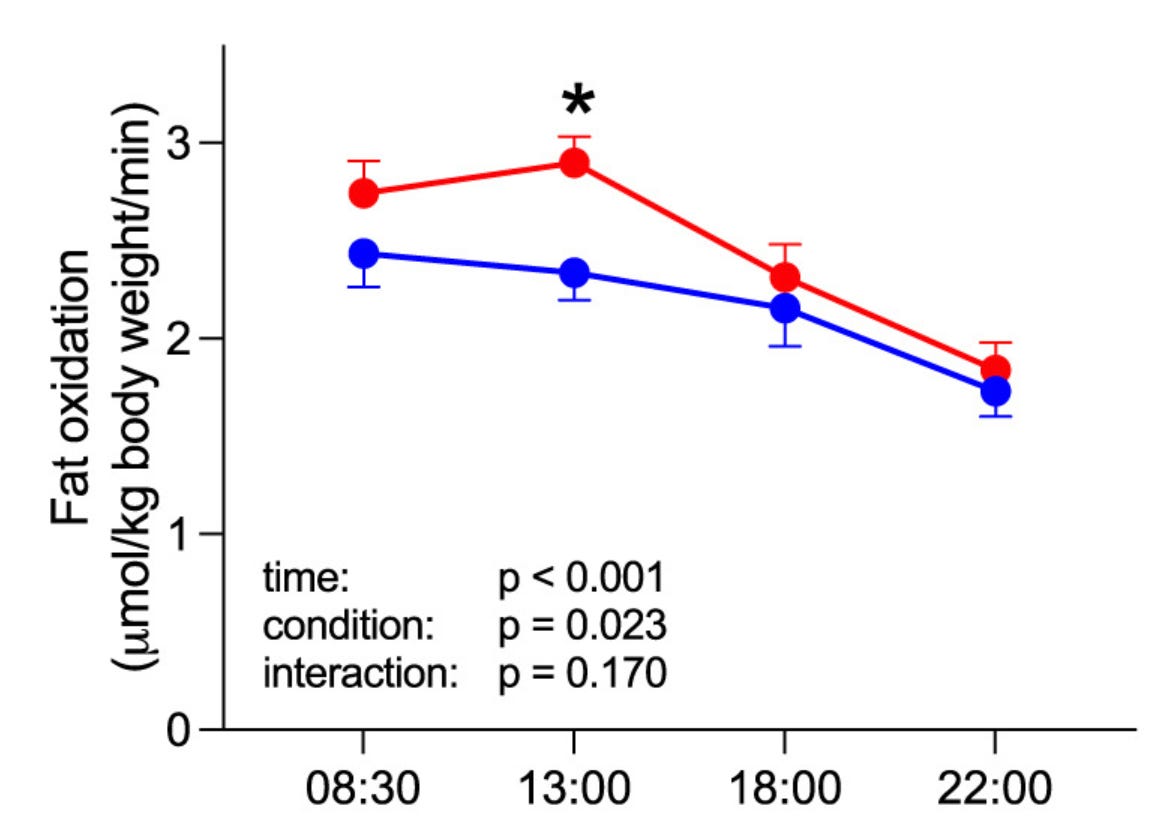
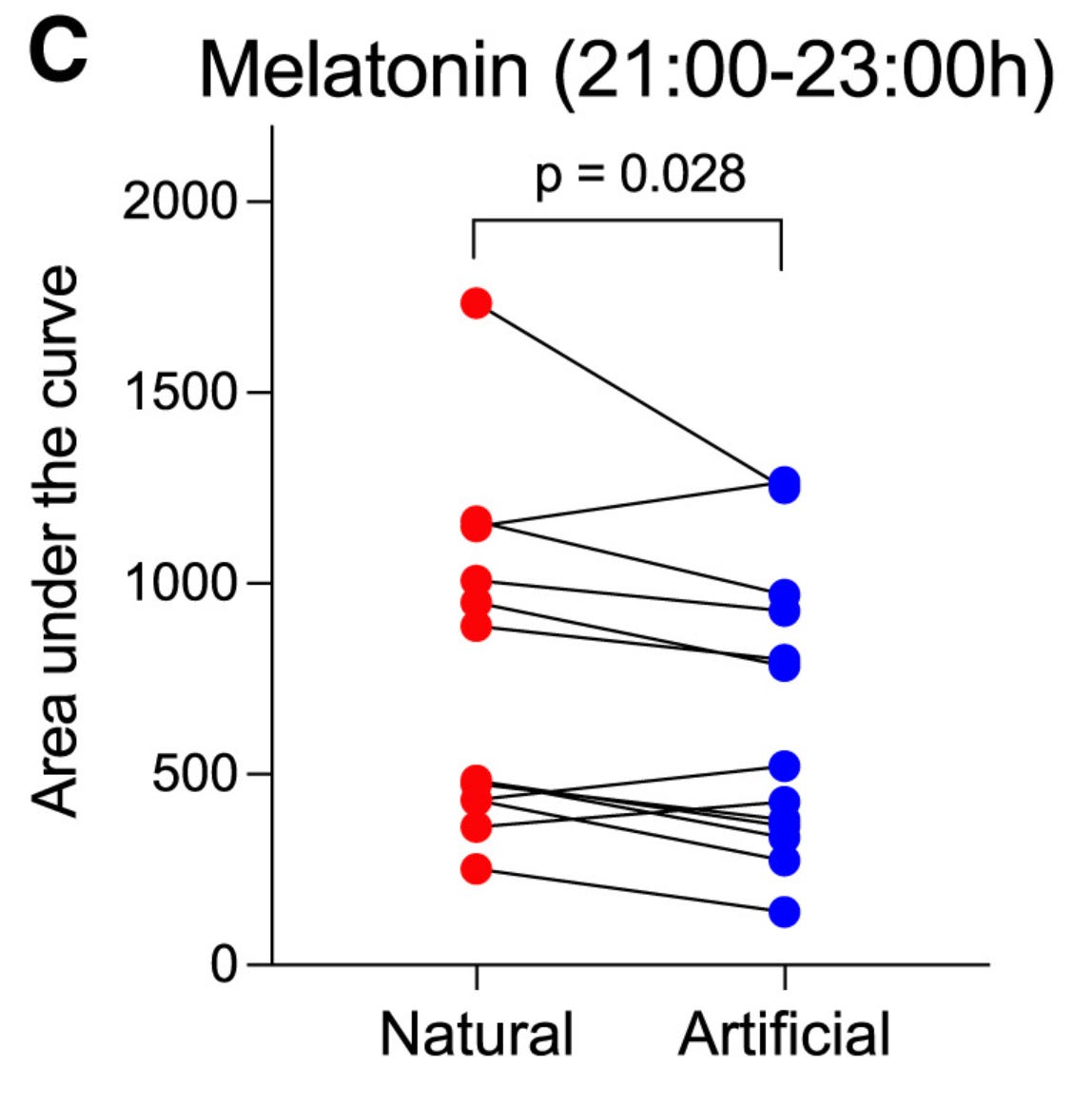
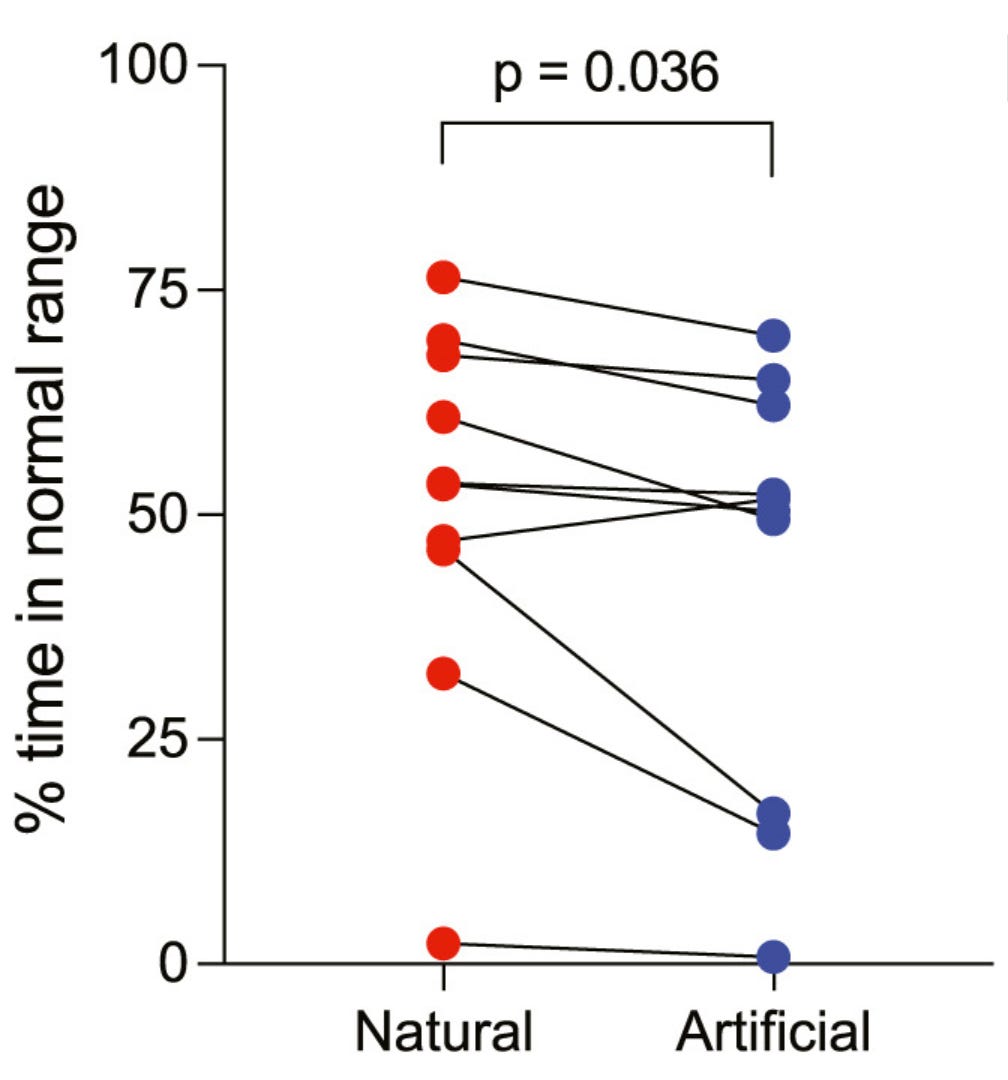
In Harmsen et al. (2026), 13 individuals spent five days in a daylit office (RED) versus a standard office lit, windowless one (BLUE). With daylight, they:
Burned more fat
Produced more melatonin that evening
Spent 51% of the day in the normal glucose range (vs. 43%)
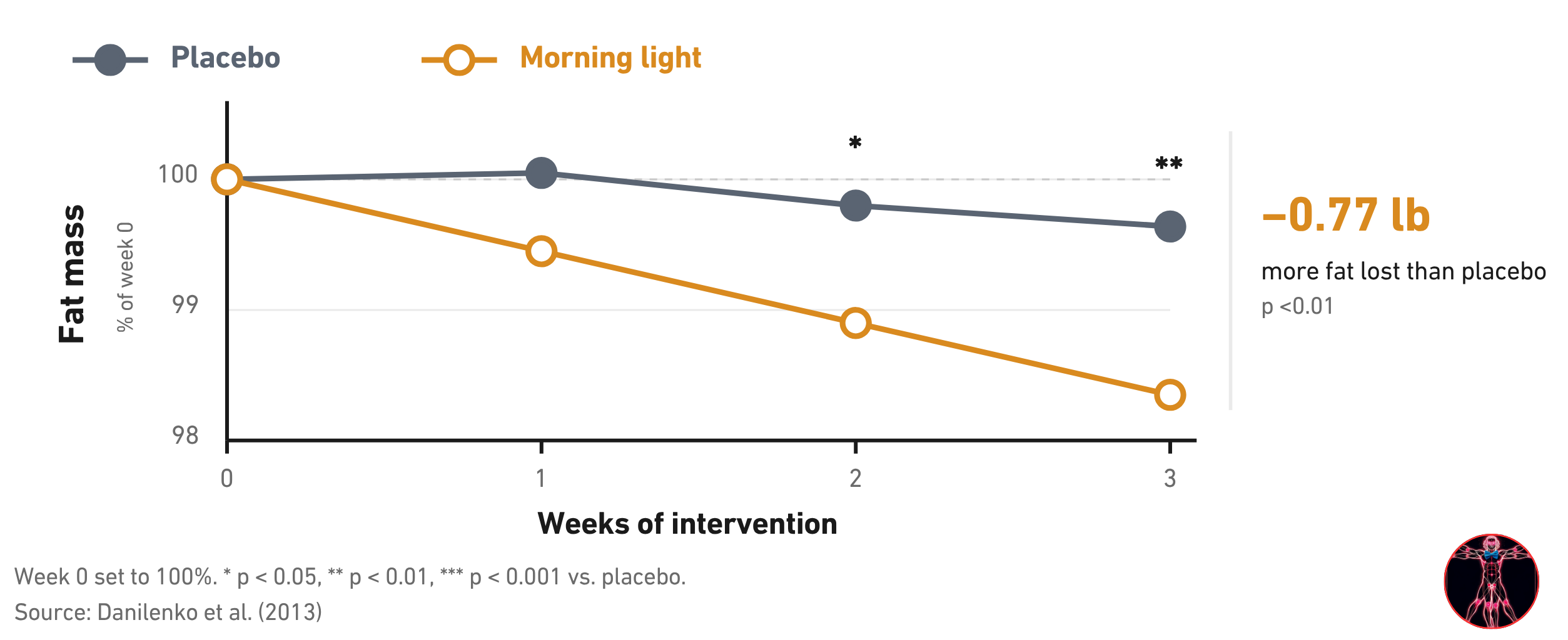
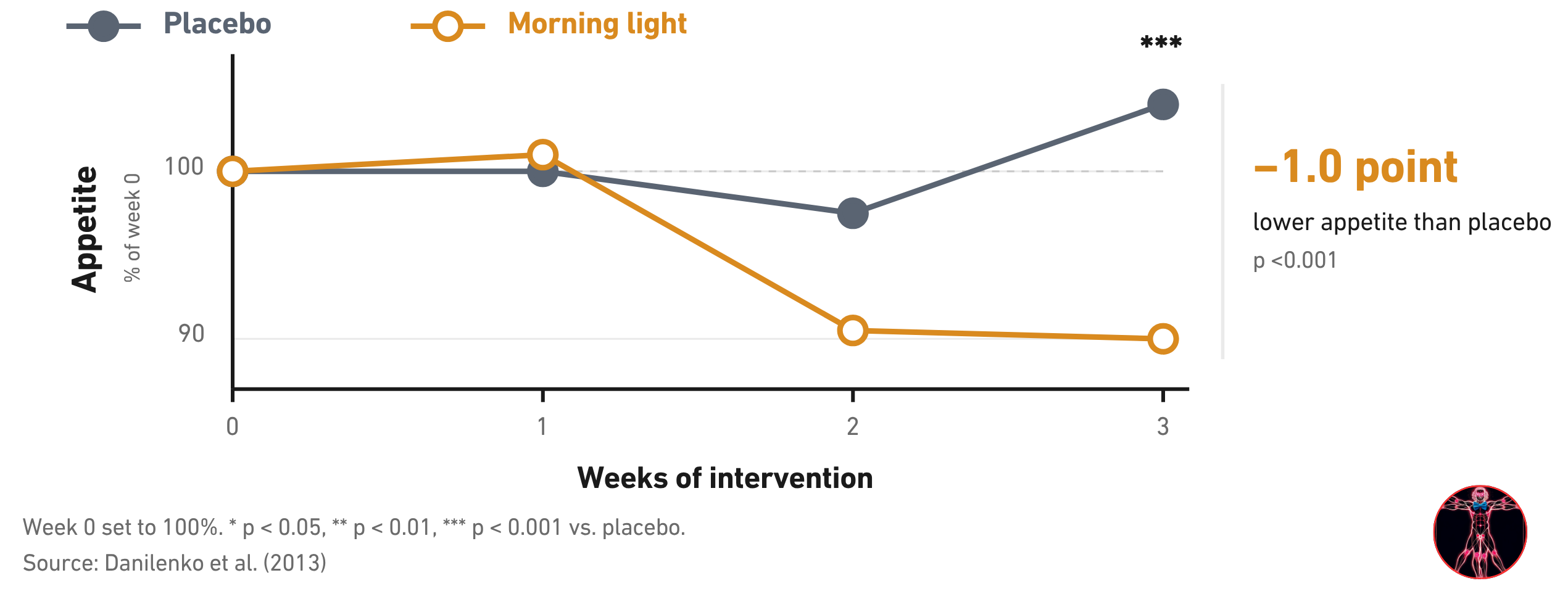
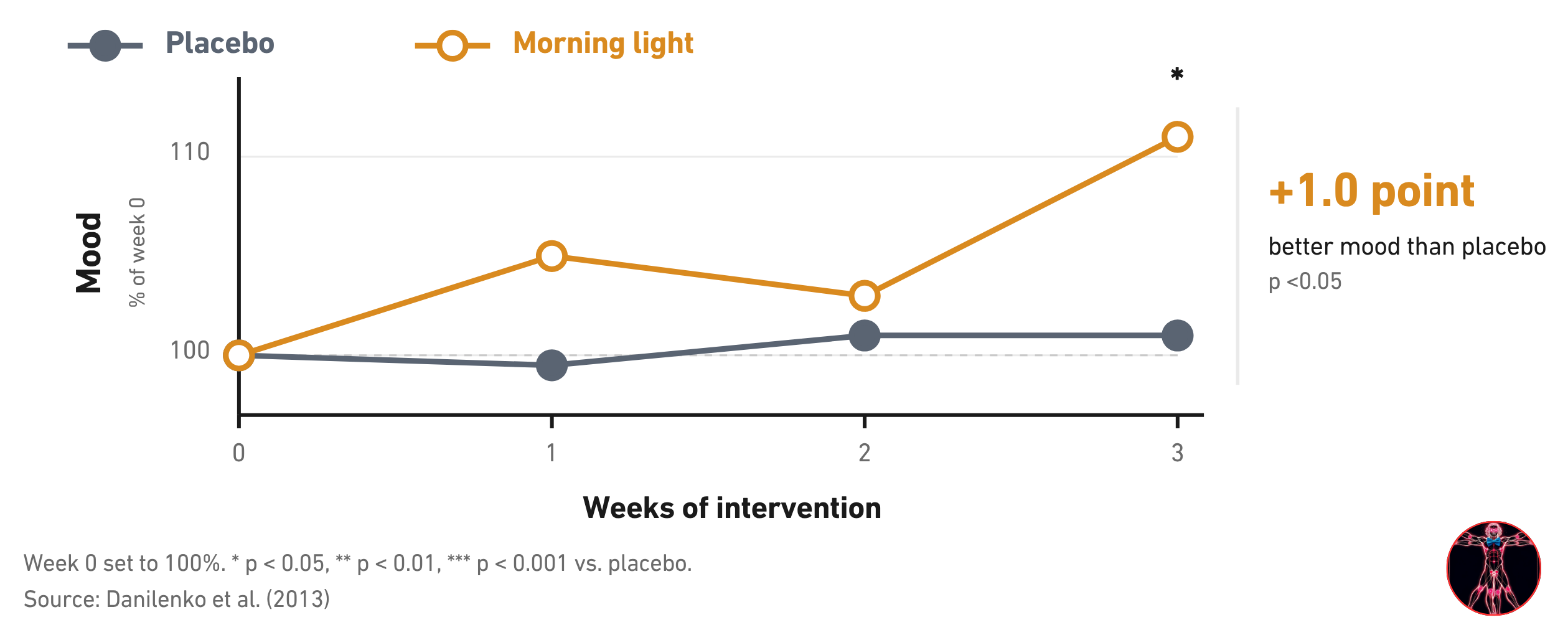
Those who got 45+ minutes of bright morning light (6–9 AM) for three weeks:
Lost more body fat
Reported lower appetite
Improved mood
Get outside within the first hour of waking each & every day.
2) Make breakfast your biggest meal
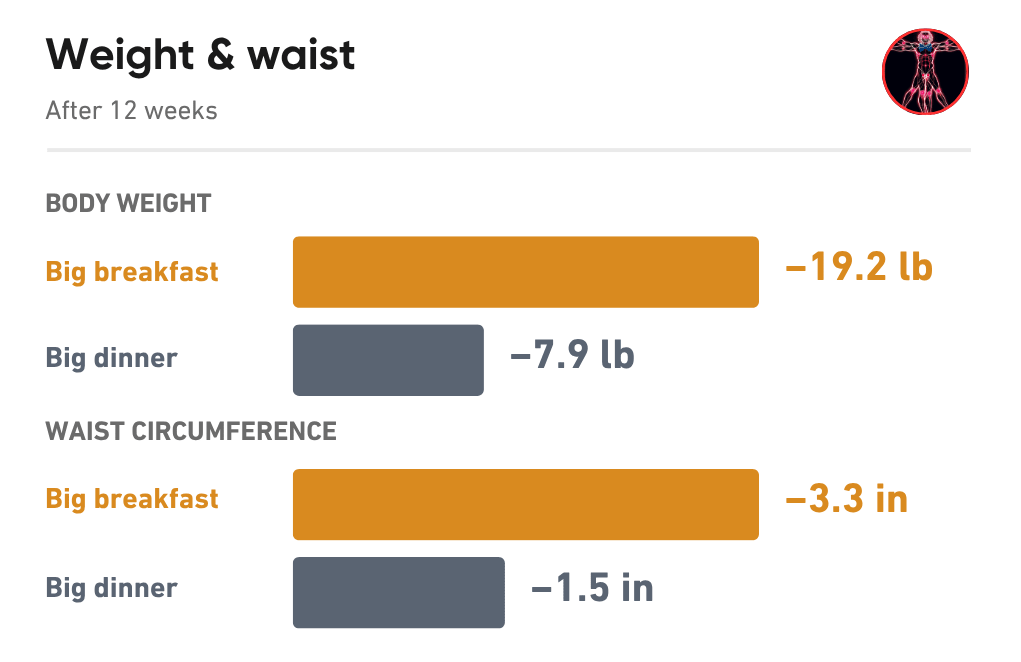
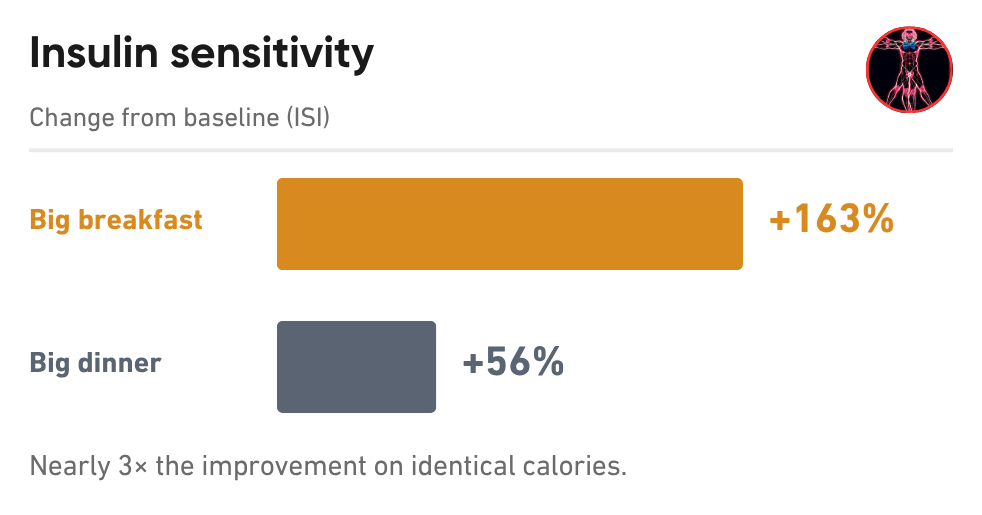
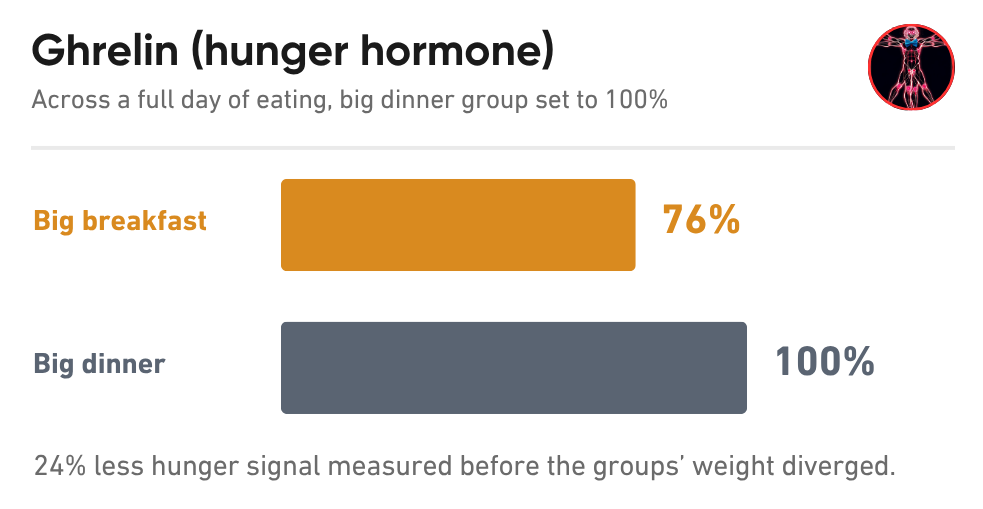
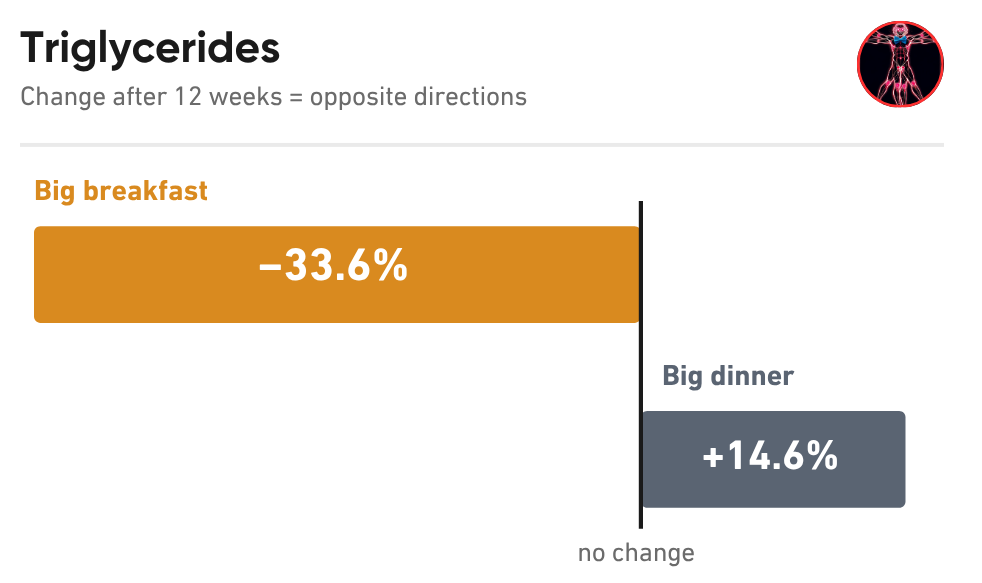
In Jakubowicz et al. (2013), 93 women had the same 1,400 cal intake for 12 weeks. The big breakfast group:
Lost more than double the weight (−19 lb vs. −8 lb) & twice the waist size (−3.3 in vs. −1.5 in)
Improved insulin sensitivity ~3x as much (+163% vs. +56%)
Measured ghrelin 24% lower
Dropped triglycerides 34% (big dinner group’s ROSE 15%)
When 420 adults ran the same 20-week weight-loss program (same calorie intake + same activity levels + same sleep, the early lunchers (those who ate their main meal before 3 PM) lost significantly more than those who ate it later.
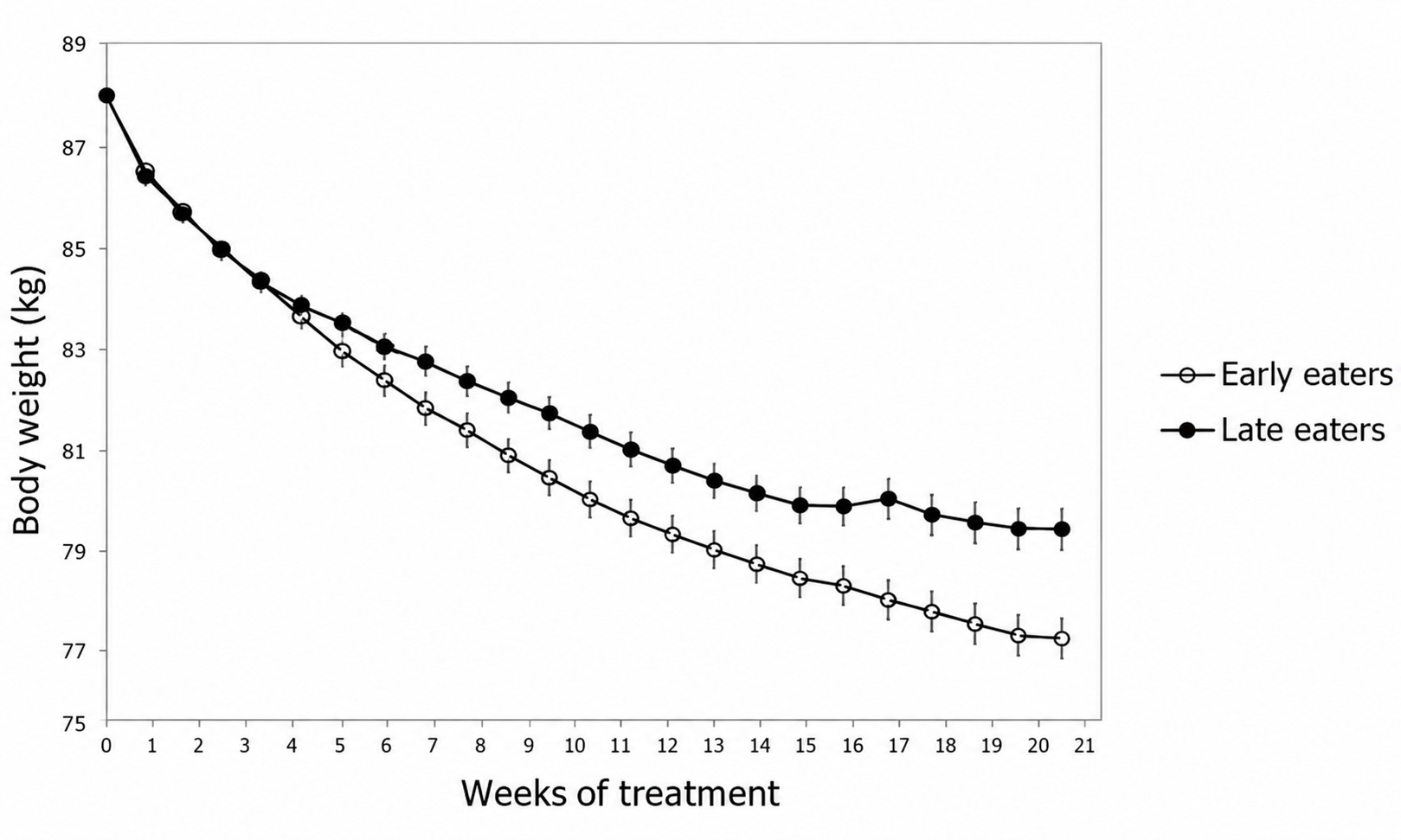
Adopt the daylight, calorie front-loaded diet → big breakfast + medium lunch + small dinner.
3) Eat at the same times every day
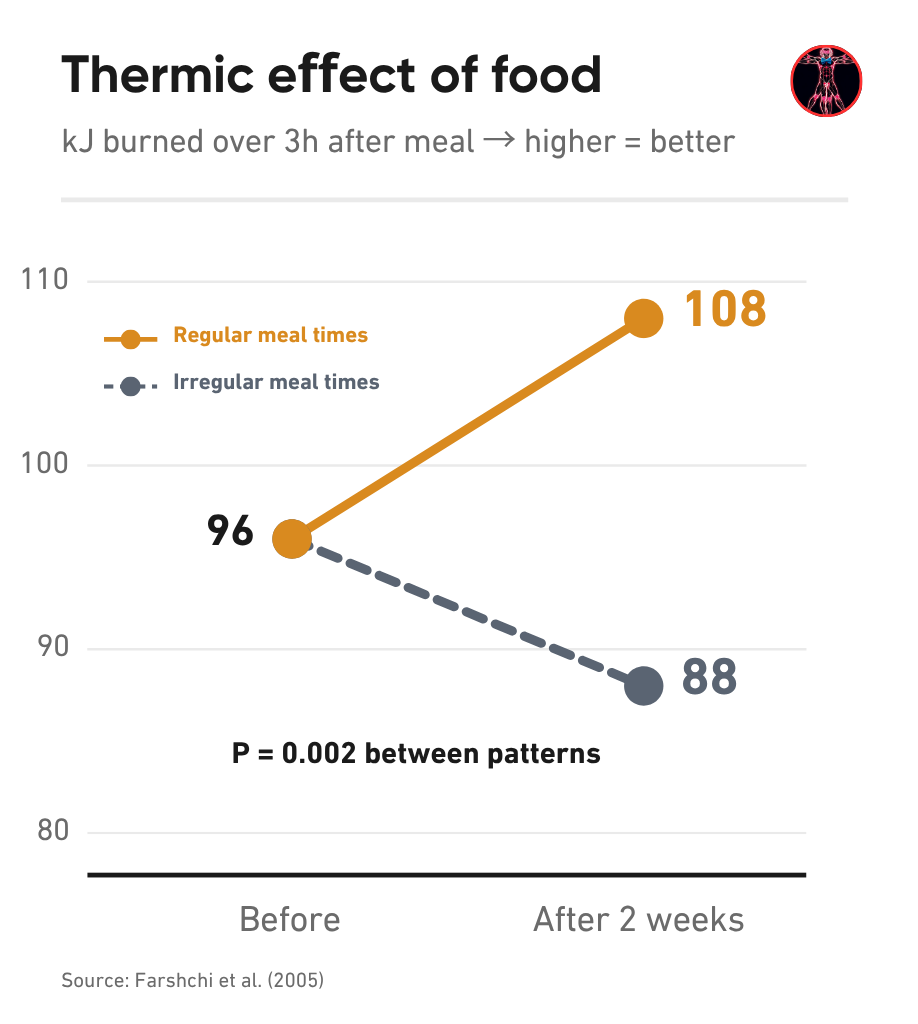
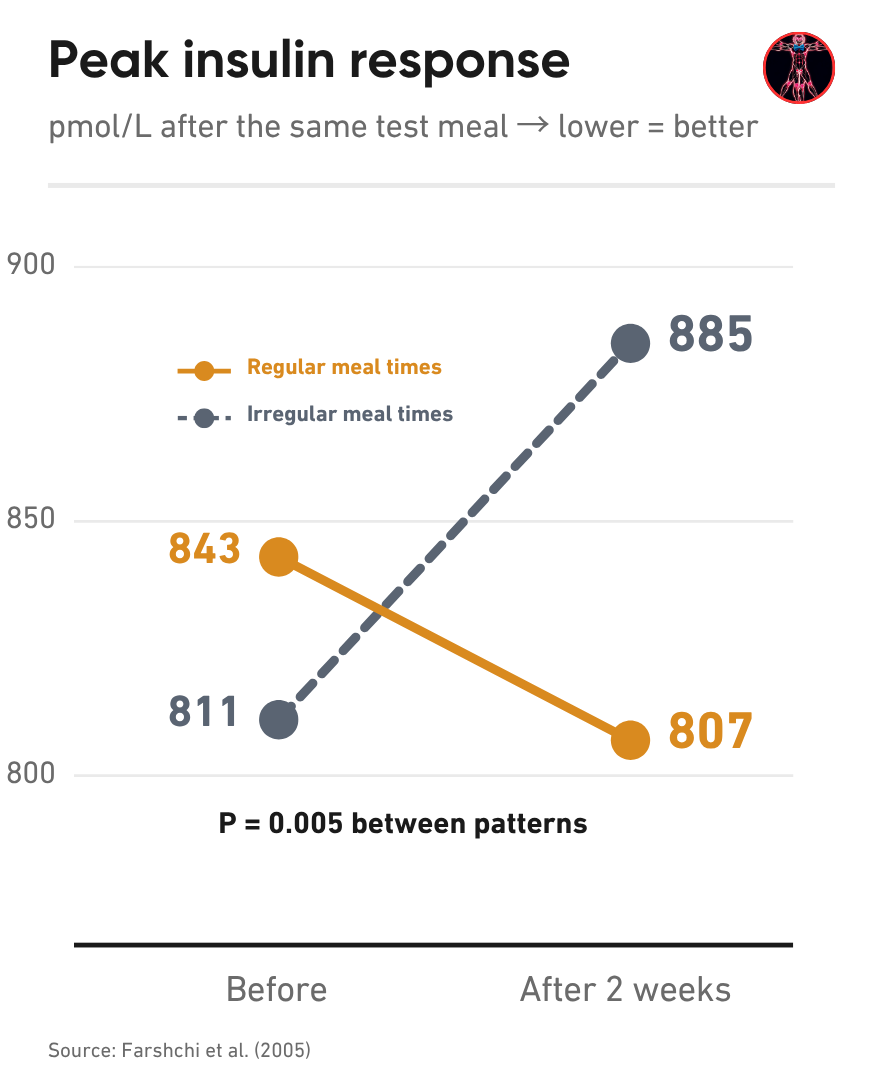
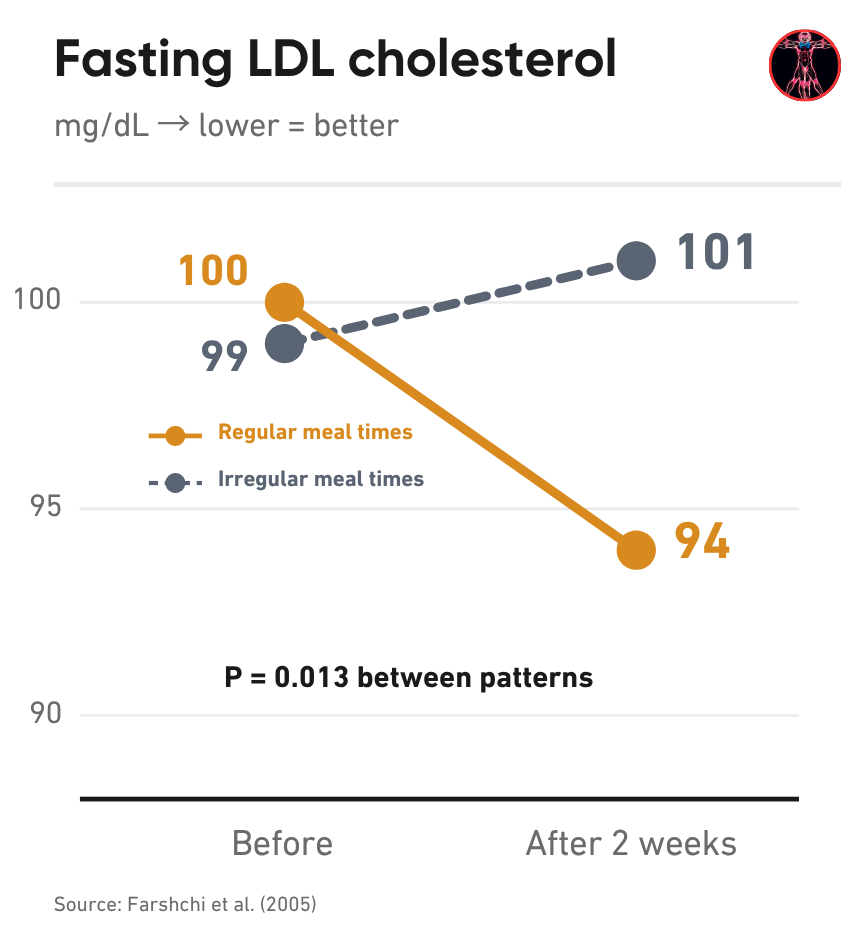
In Farshchi et al. (2005), a regular eating pattern across a two-week period produced:
Higher thermic effect of food (greater energy expenditure)
Lower insulin response
Better fasting LDL-C
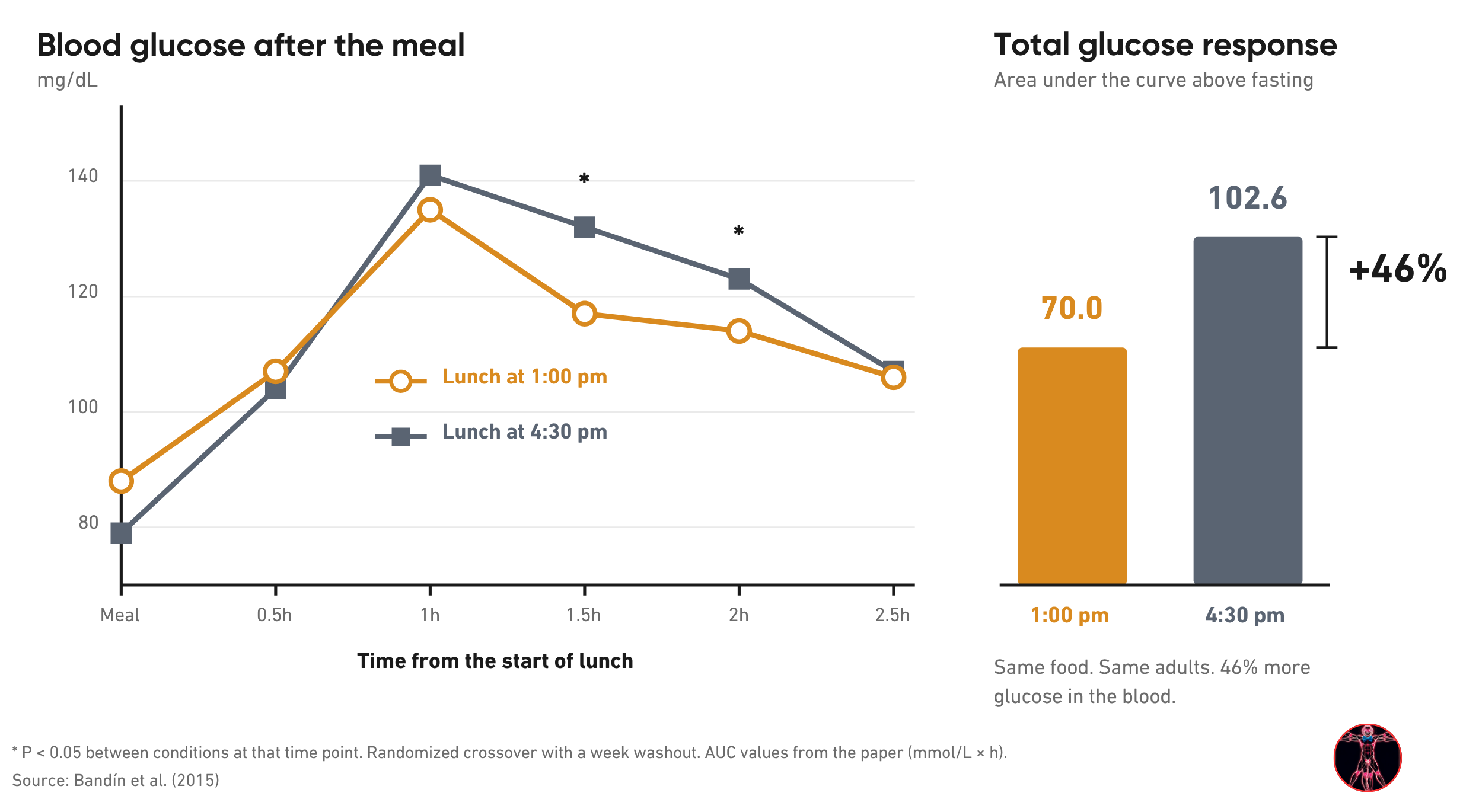
Even a slight delay in eating schedule can have a metabolic cost. Shifting the same lunch from 1 PM to 4:30 PM raised the glucose response by 46%.
Pick your meal times and hold them constant (weekends included).
4) Stop eating 2—3 hours before bed
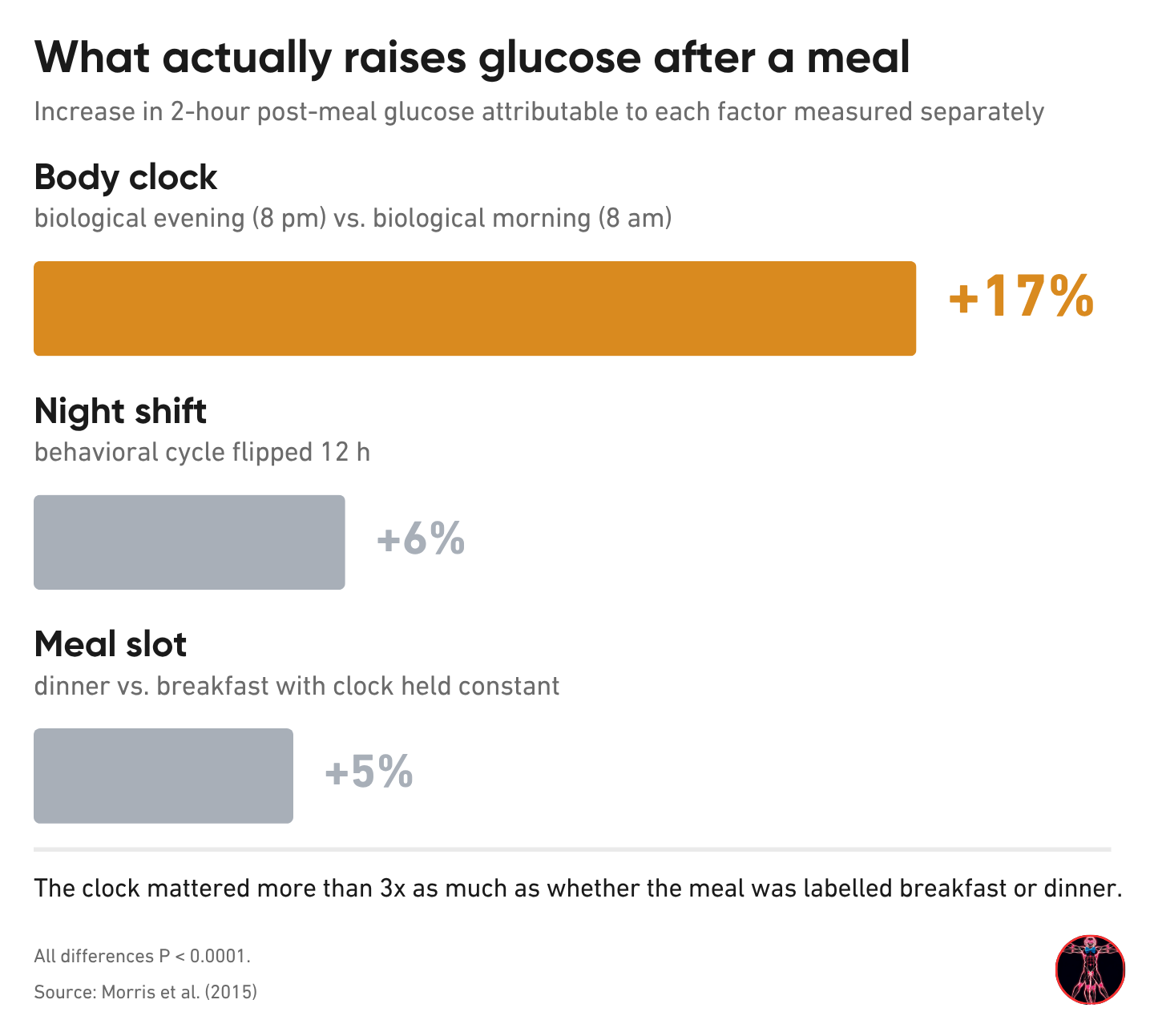
Glucose tolerance was 17% worse at night than it was in the morning.
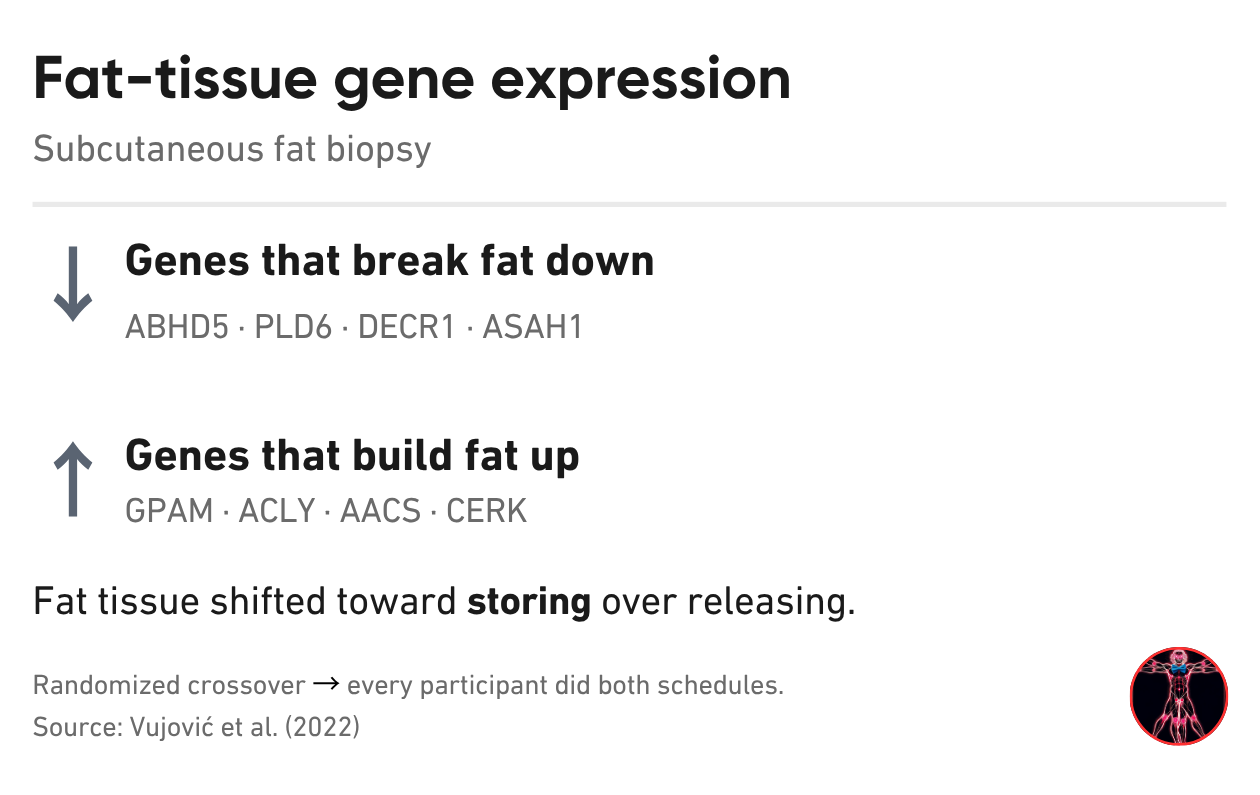
Vujović et al. (2022) showed this in a controlled setting when they fed 16 adults identical meals → one on an early schedule and the other shifted 4 hours later.
Eating late:
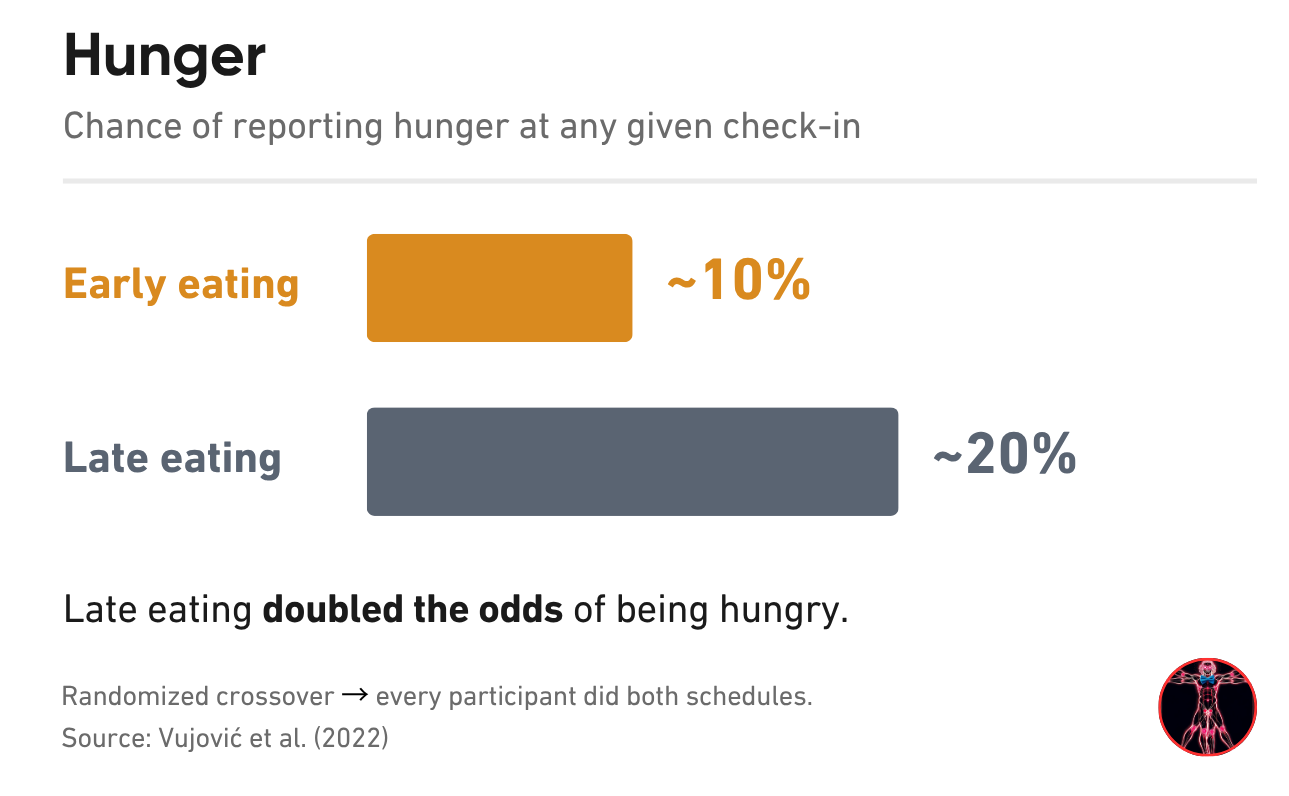
Increased hunger
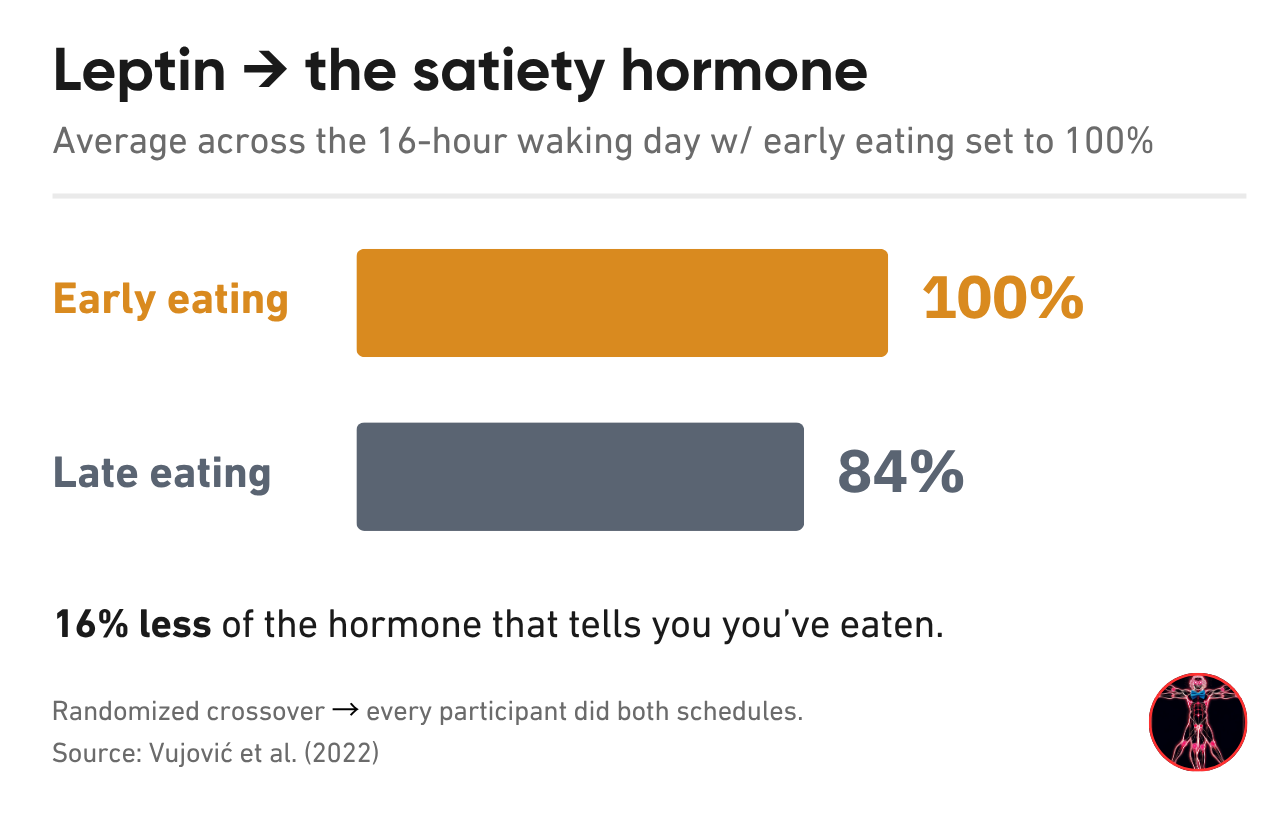
Lowered 24-hour leptin (satiety)
Reduced energy expenditure while awake
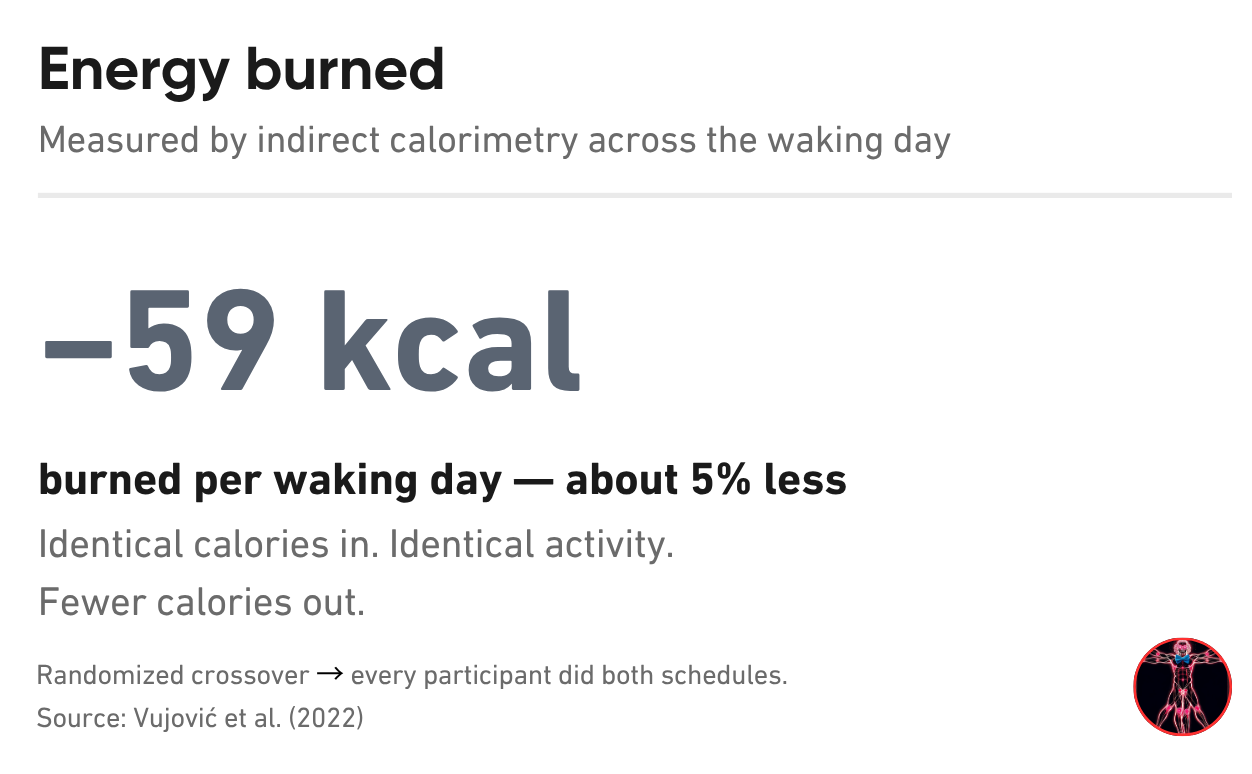
Shifted fat-tissue gene expression toward storing fat (& mitigated fat loss)
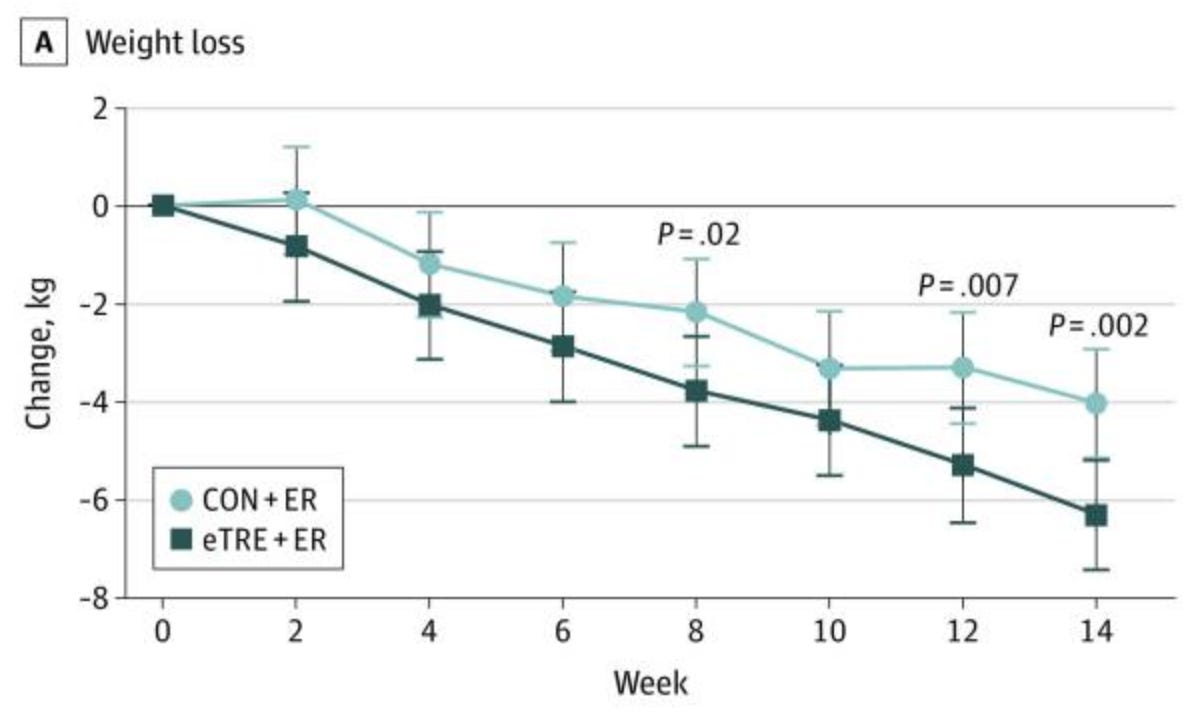
Invert it and early eating windows prove to be more metabolically efficient. In Jamshed et al. (2022), 90 adults did the same fat loss program eating at either 7 AM–3 PM (eTRE) or across 12+ hours (CON). The early group lost 13.9 lb vs 8.8 lb in 14 weeks and reduced diastolic blood pressure an extra 4 mmHg.
Finish your last meal 2–3 hours before bed.
5) Keep your nights dark
20 healthy young adults slept under two conditions: 1) dim overhead room light (100 lux) or 2) near-darkness (3 lux). The lit group’s:
Heart rate stayed higher all night
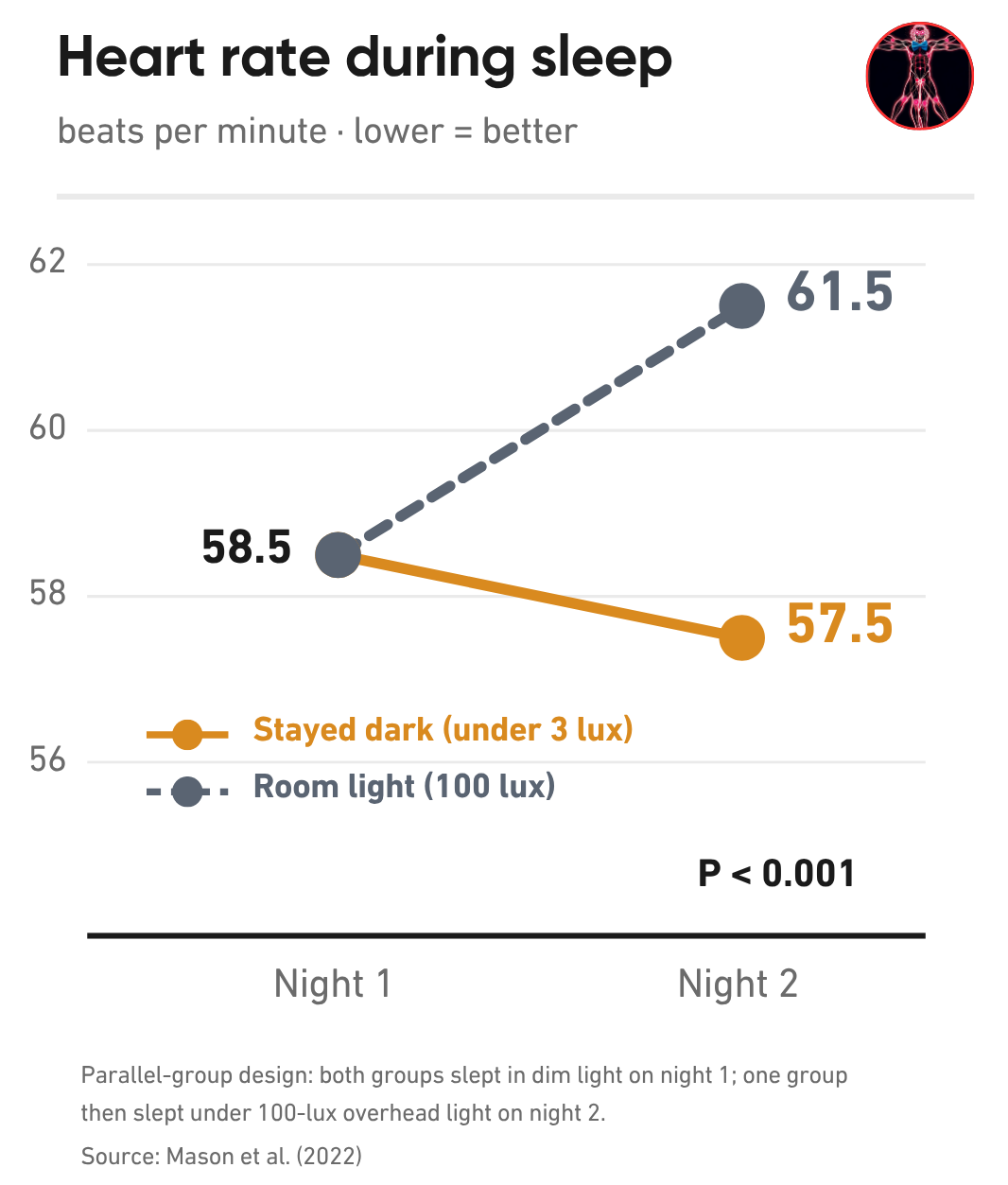
Woke up more insulin resistant
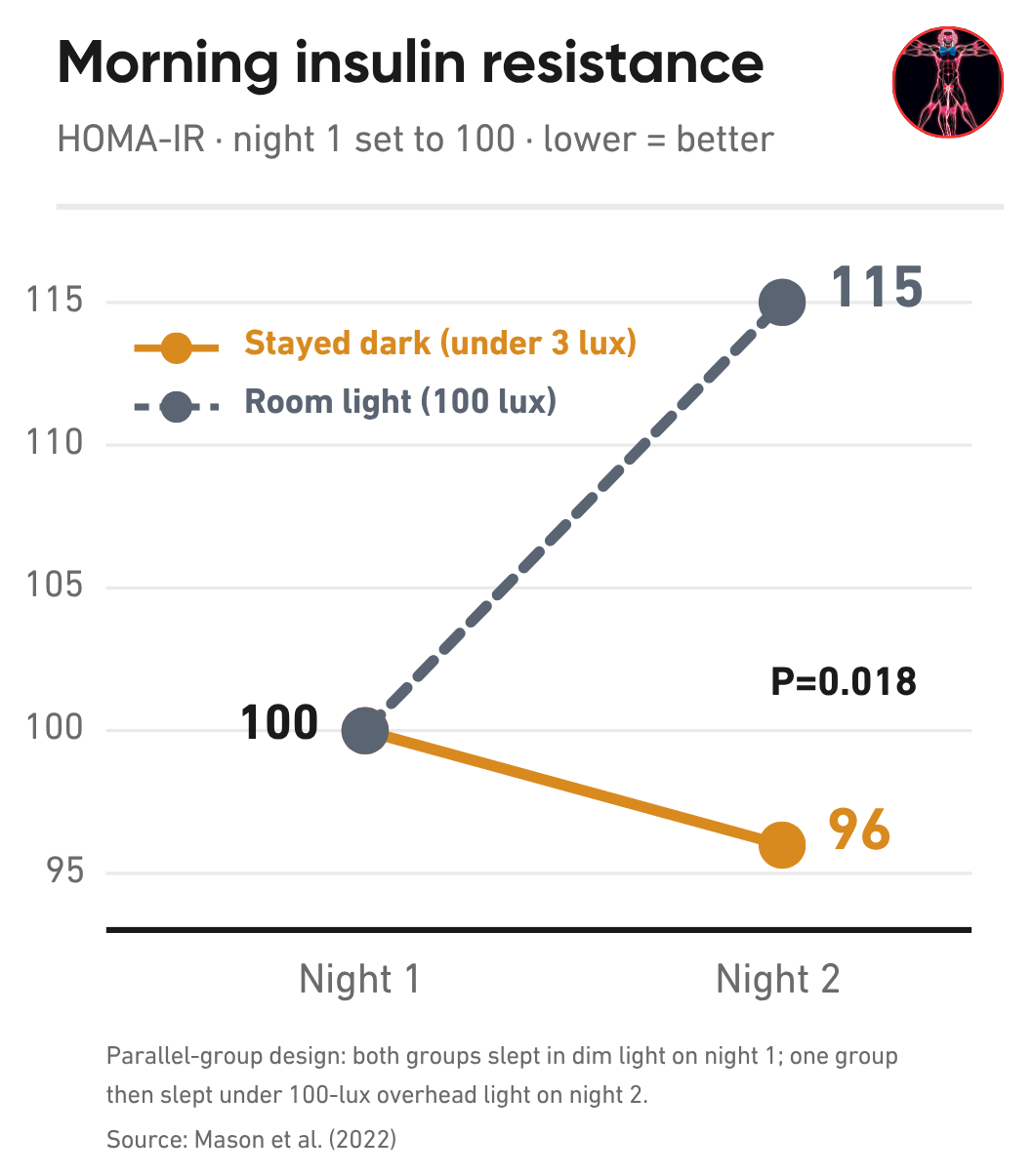
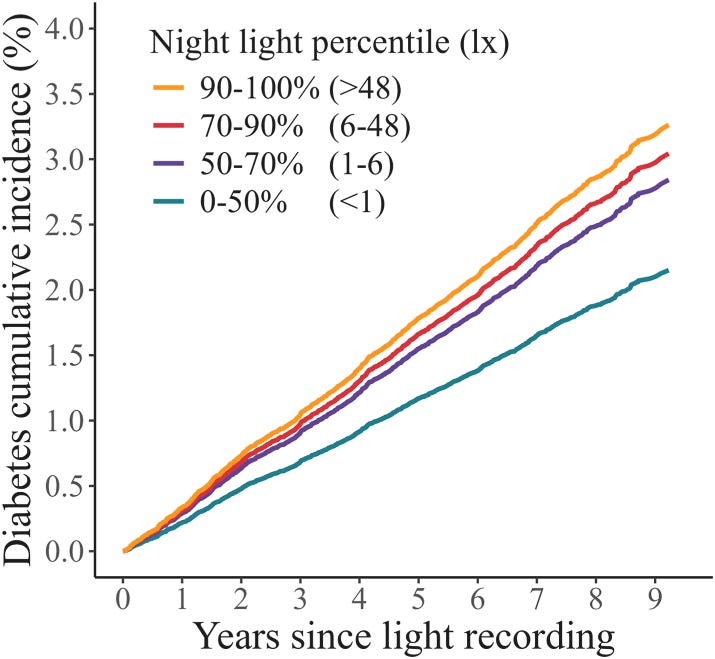
When you scale this phenomenon out to ~85k adults over an 8-yr period, those with the brightest nights had a 53% higher risk of type 2 diabetes than those with dark nights.
Blackout shades. Sleep mask. Red incandescent bulbs for the bedroom.
6) Sleep on a fixed schedule
A point sleep reductionists (“you need 8 hrs”) have missed in the last few decades: sleep regularity is as important as sleep quality (& far more than duration alone).
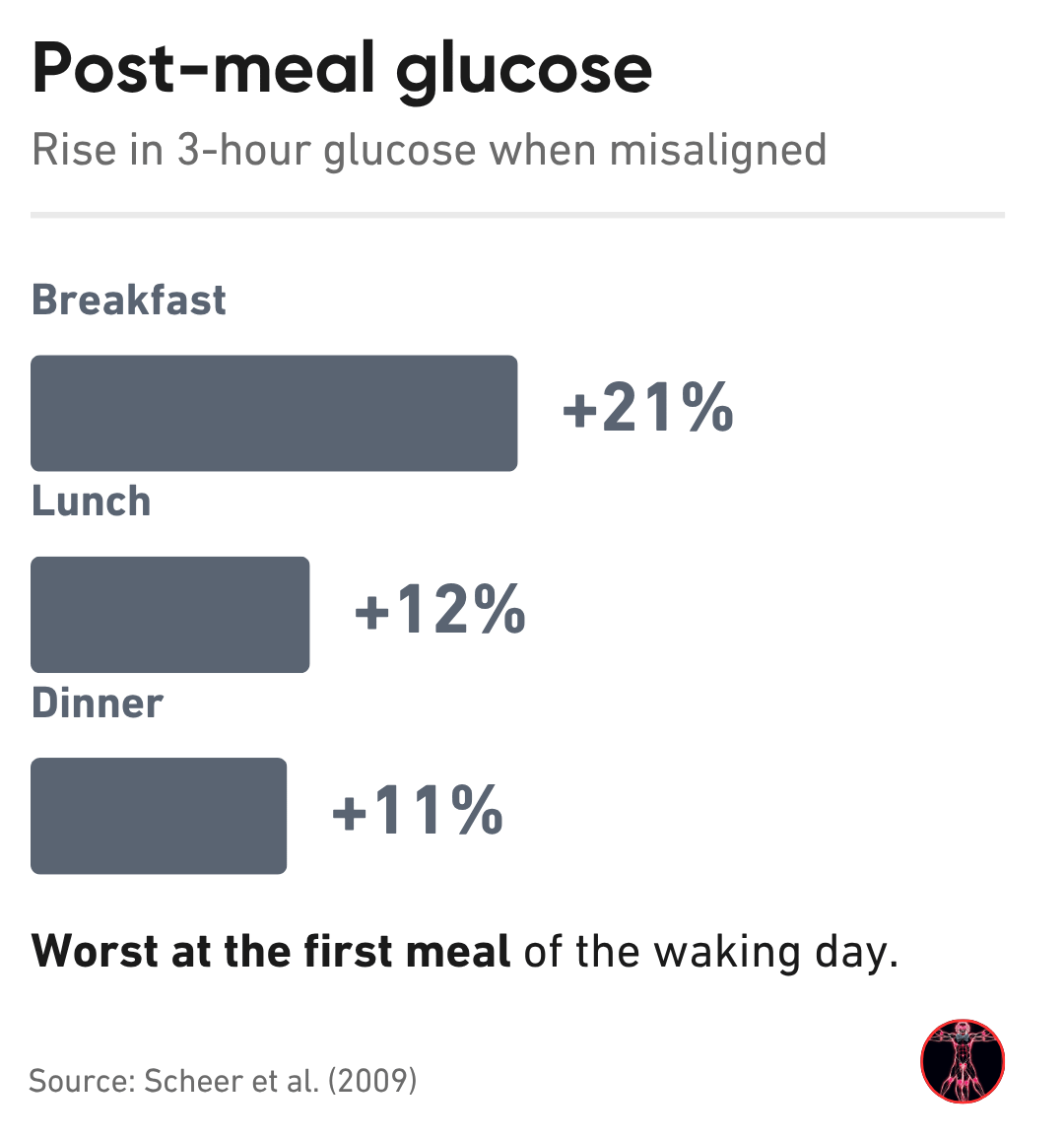
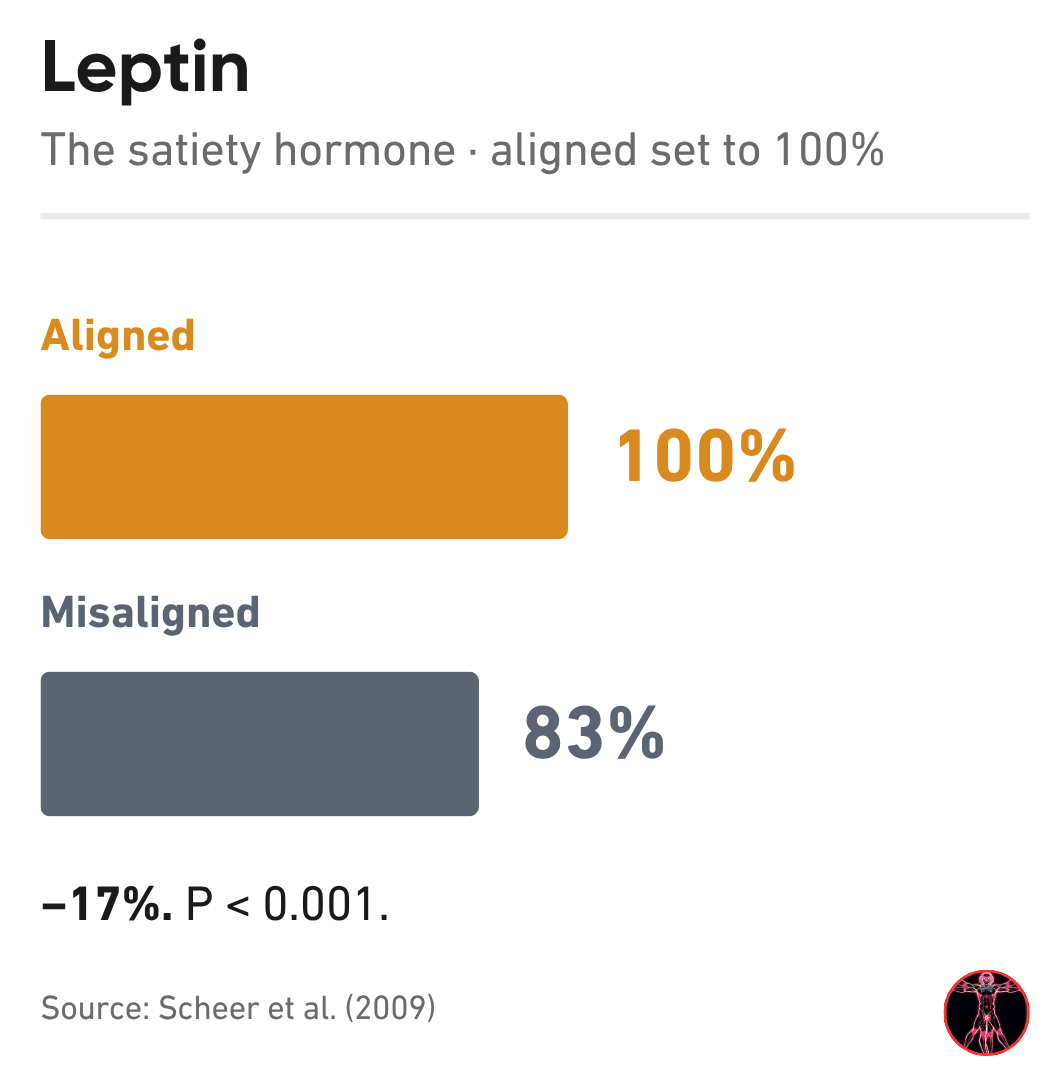
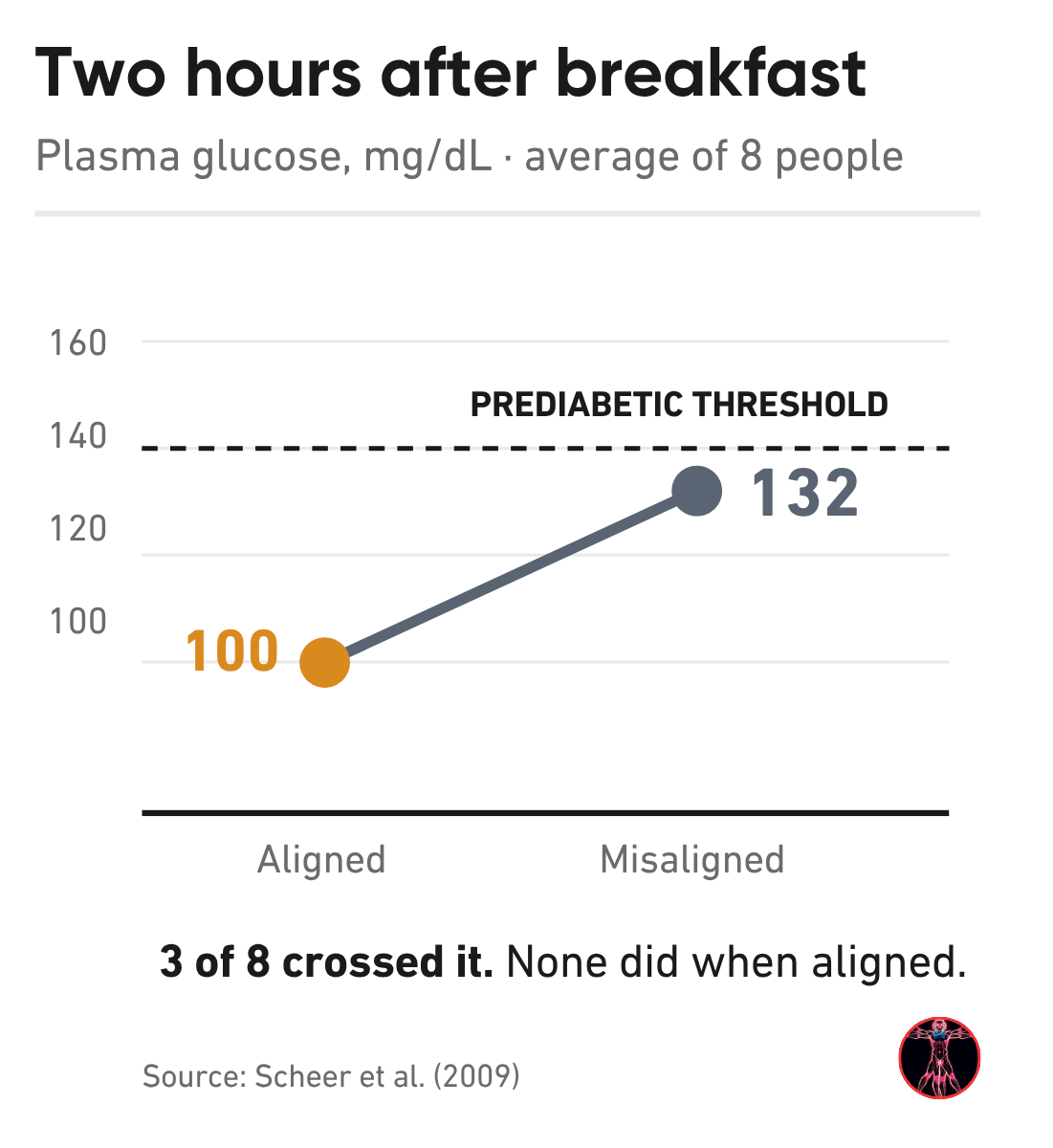
Scheer et al. (2009) showed that when sleep and meals are pushed out of sync:
Post-meal glucose rose up to 21%
Leptin fell 17%
3 of 8 healthy subjects produced prediabetic glucose responses
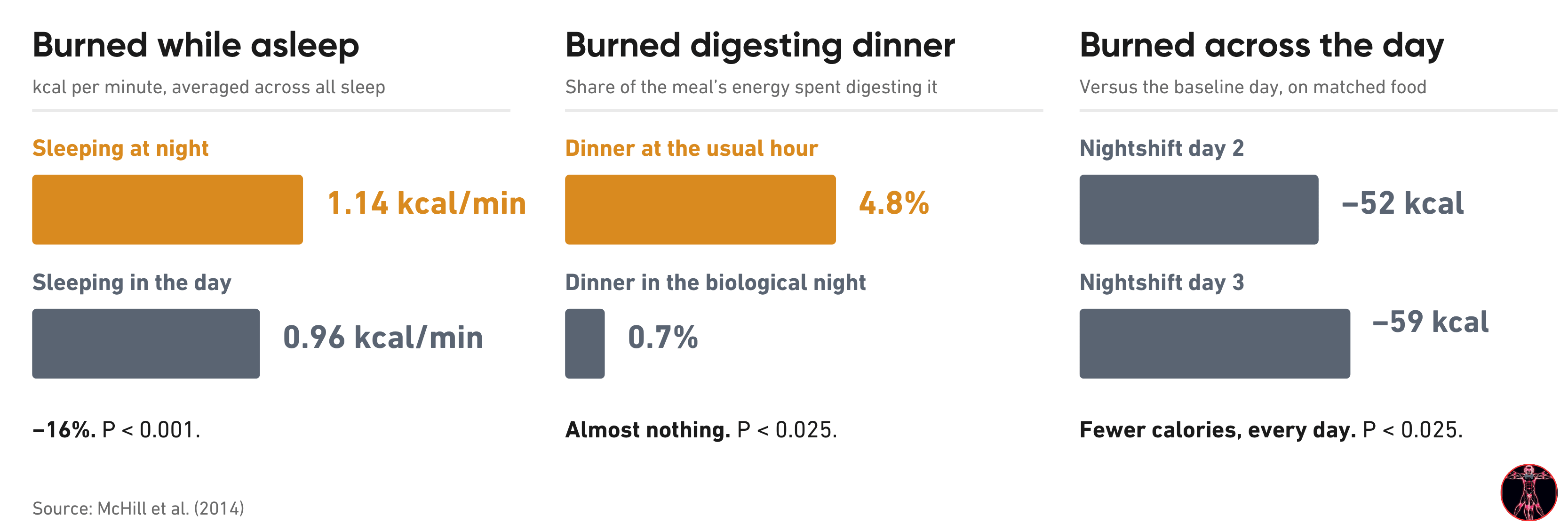
Mistimed sleep also burns less. Sleeping during the day instead of at night reduces caloric burn during sleep by up to 16%.
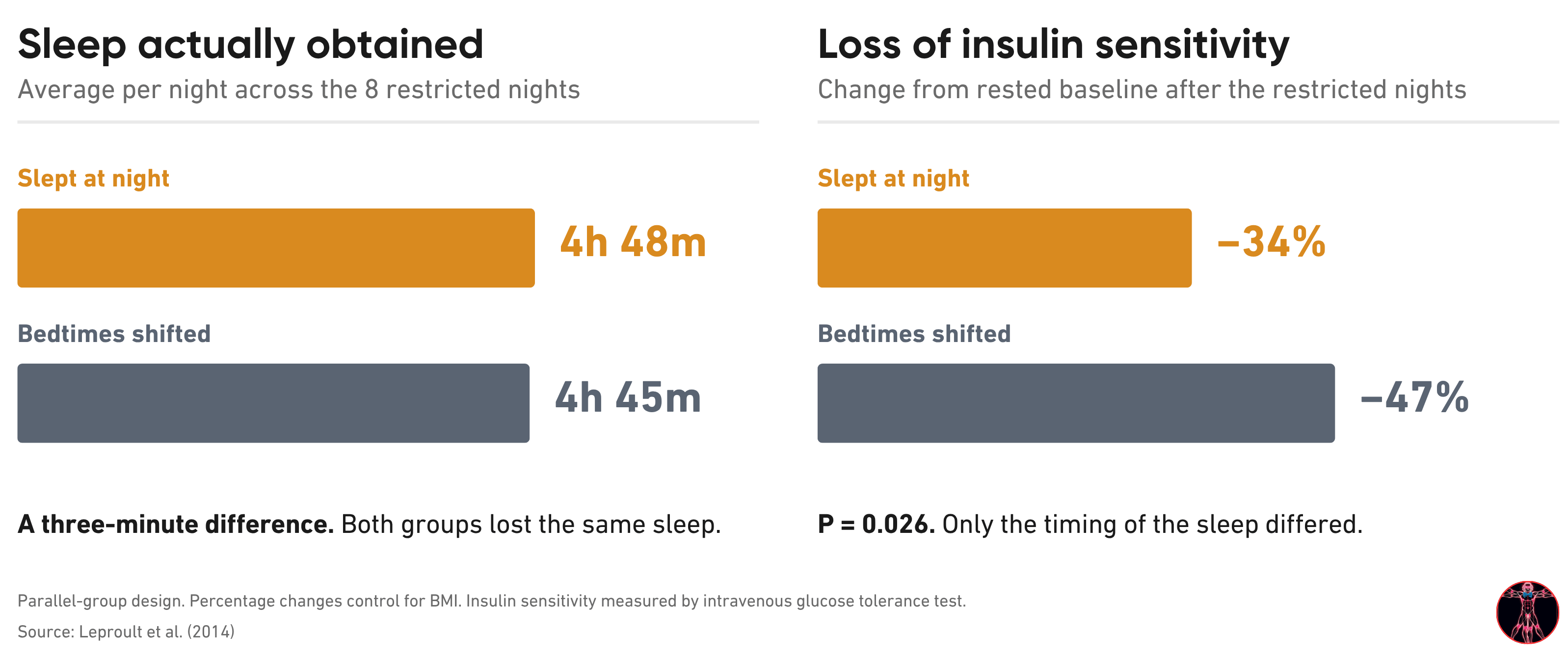
And when two groups got the same amount of sleep restriction, the mistimed group lost 47% of their insulin sensitivity vs. 34% in the group that slept at the right time.
Keep consistent bedtime & wake times within 30—45 min (including weekends). If working night shift, eat during daylight hours.
7) Draw bloods at the same time of day
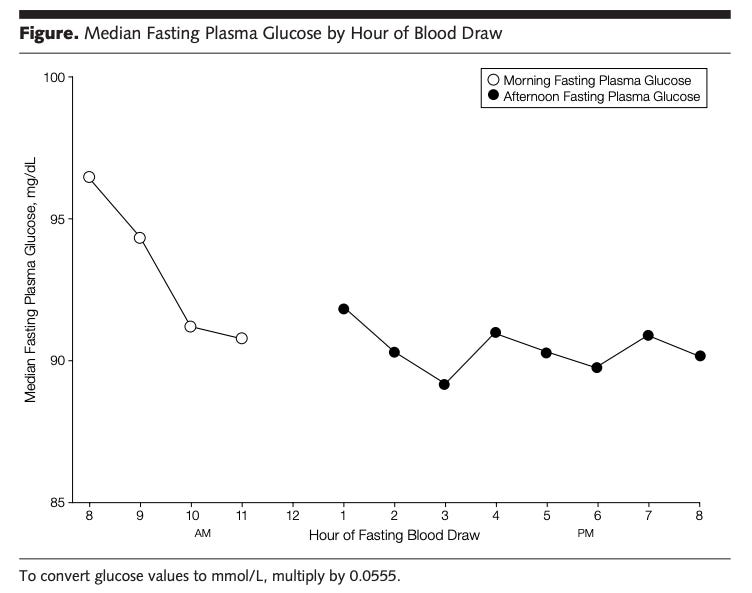
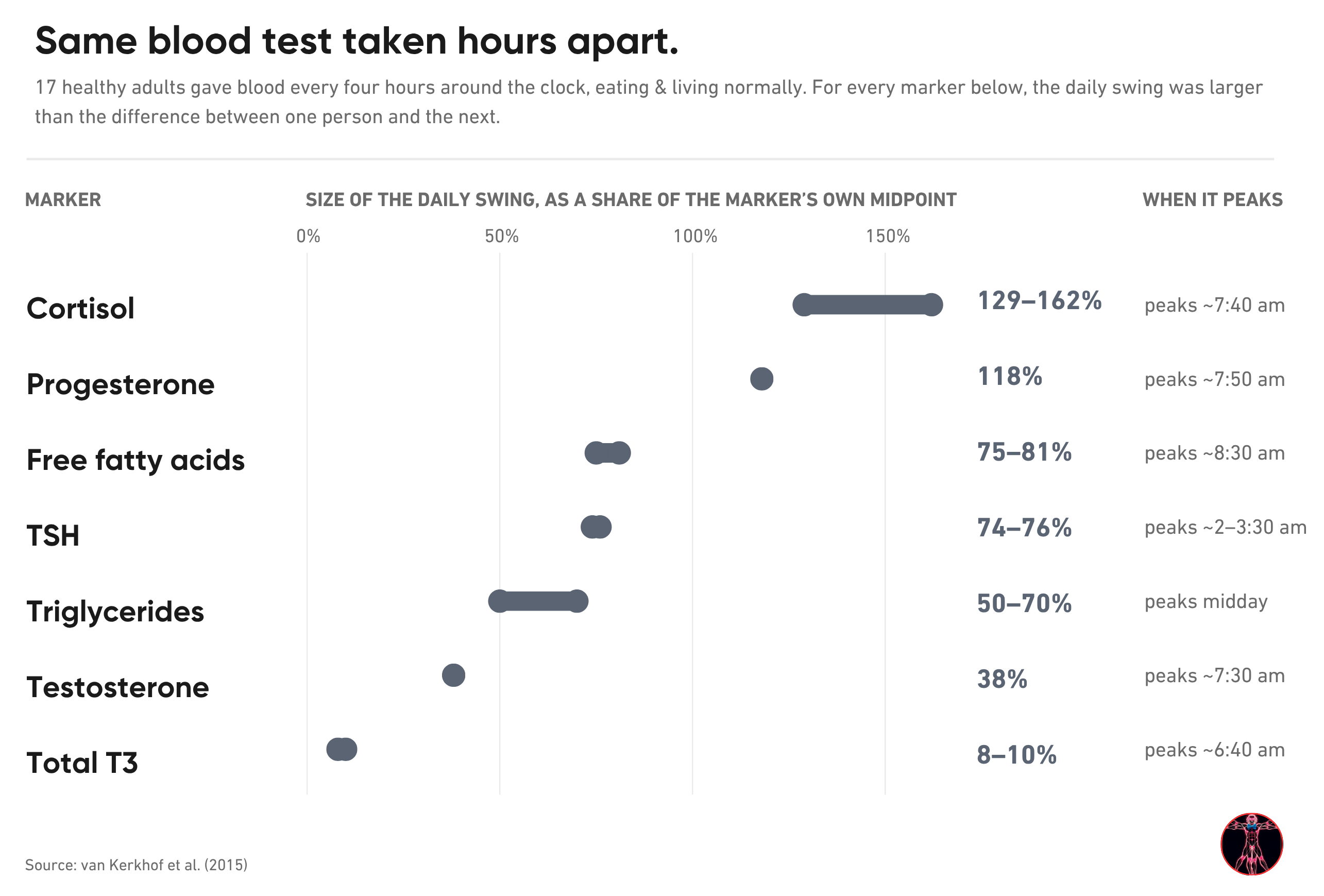
Cardiometabolic & hormonal biomarkers vary widely across any given day.
Across a ~13k adults, AM draws averaged 97 vs. 92 mg/dL for afternoon draws. Diabetic readings even showed up half as often in the afternoon & dysregulated fasting glucose 3x less often.
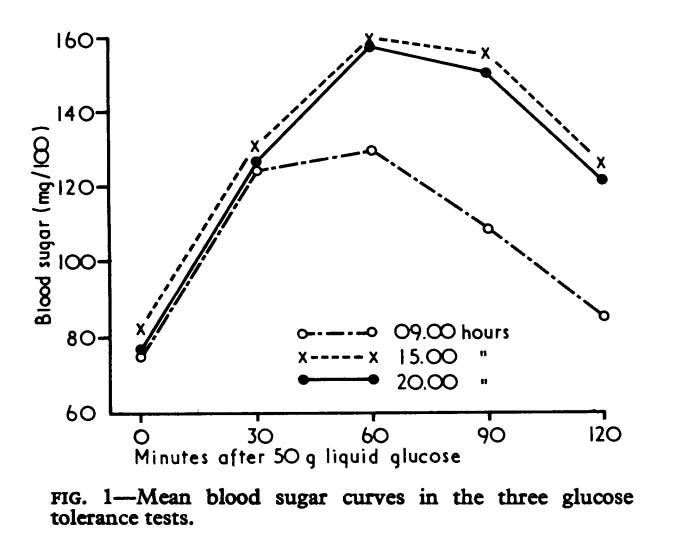
Important to keep insulin sensitivity variation in mind for any glucose tolerance testing as well. When Jarrett et al. (1972) administered the same glucose tolerance test at 9 AM, 3 PM, & 8 PM, afternoon & evening glucose came back significantly higher.
Lipids, thyroid markers, androgens, & glucocorticoids all swing internal to the day too.
Avoid the variation & consistently draw while fasted first thing in the morning.
8) Front load protein
I’m sure it’s sunk in by now, but in case not: skipping breakfast is a great way to spin your wheels if you’re trying to add lean muscle (glucose sink) over time.
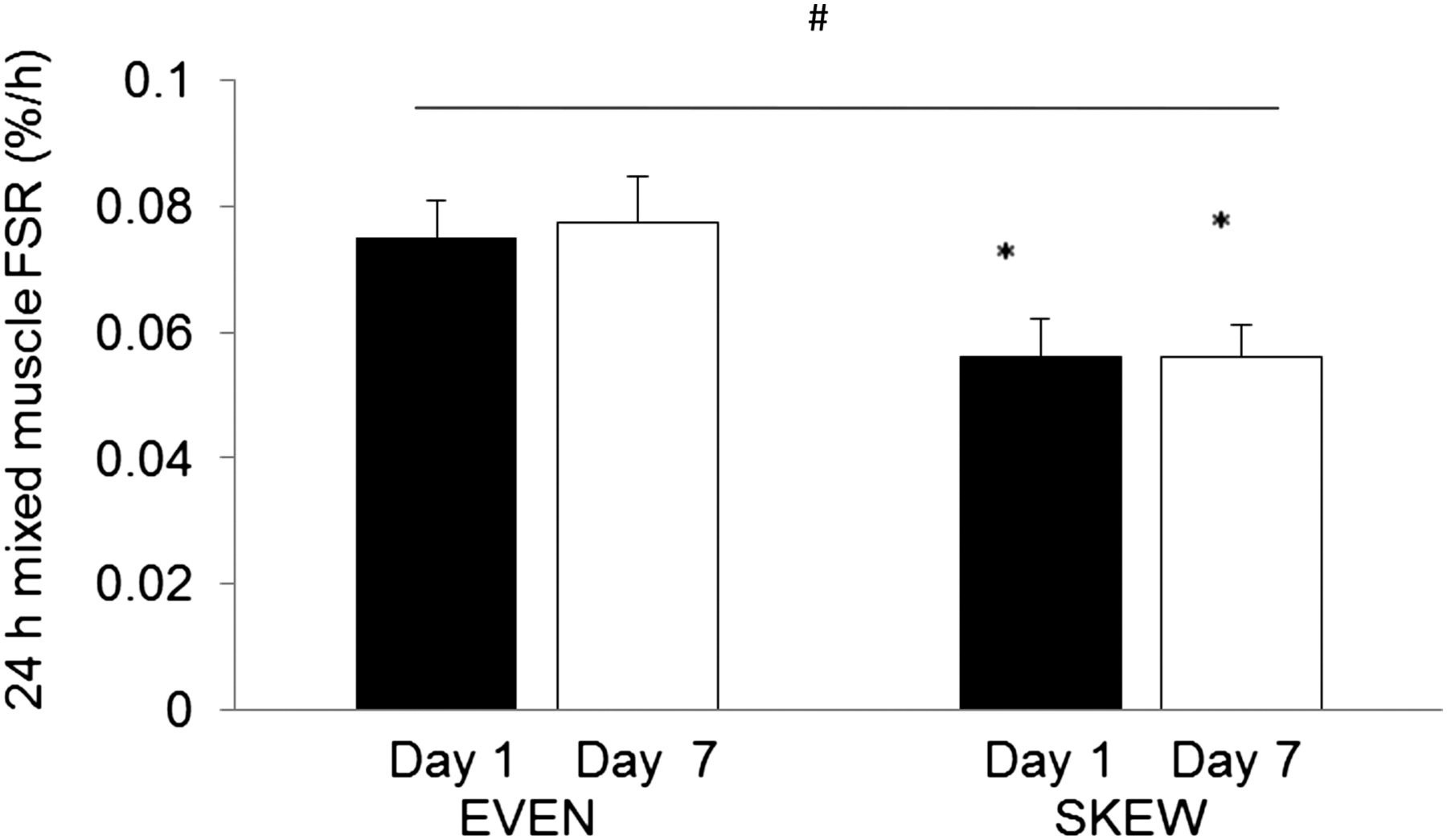
The same total protein split 30/30/30 g (EVEN) across three meals instead of 10/15/65 g (SKEW) produced 25% more muscle protein synthesis over 24 hours.
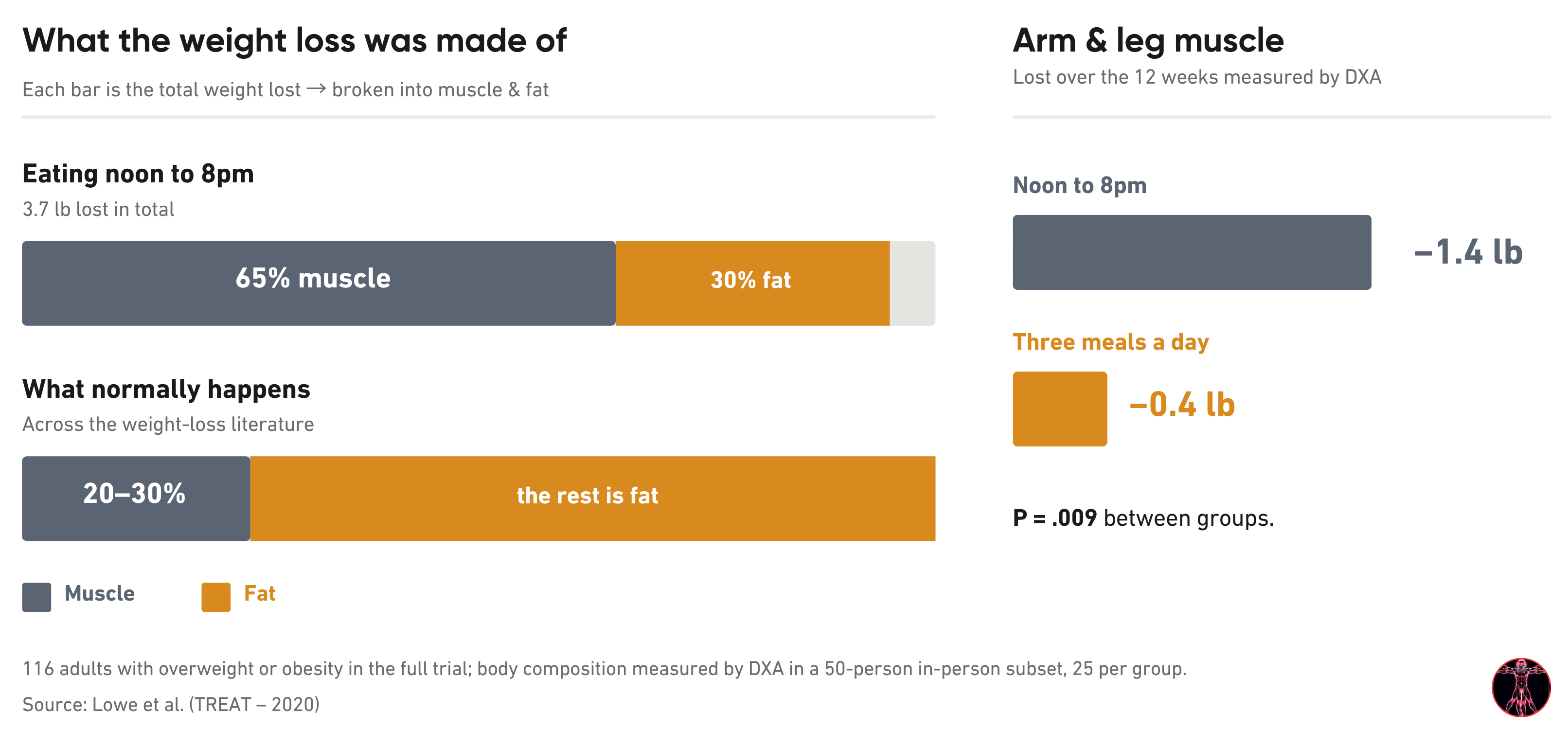
The TREAT trial showed this exactly. Those who skipped breakfast for 12 weeks lost significantly more arm & leg lean mass than those eating three regularly timed meals.
Get the early morning 30+ g bolus upon waking.
9) Train the early chronotype
Across ~64k nurses followed for eight years, definite night owls had a 19% higher risk for type 2 diabetes even after accounting for diet, weight, & activity.
“But what if I’m a natural night owl?”
Here’s the good news: with the right inputs, chronotypes are highly trainable.
All it took for 22 night owls was three weeks of earlier morning light, dark evenings, fixed sleep times, & no dinner after 7 PM. They shifted their internal clocks two hours earlier with 1) no lost sleep, 2) lower depression & stress scores, and 3) better morning reaction time & grip strength.
Three big takeaways for you this week:
Circadian regulation is the bedrock of all health systems.
Inputs matter. But timing matters equally as much.
The best stacks remain in nature & virtually free.
See you guys next week.
— Phys
If you found this useful for improving your life, here are some others you’ll find practical:


Excellent article and research review.