


Your phone is making you dumber. You know this of course. But what’s less known is even its proximity alone is destined to nuke your cognitive superpower potential.
You think face-down is enough.
You think off your desk is enough.
You think do not disturb is enough.
Nope.
Here’s why you’re not all you could be with your phone in the room.
The Brain Drain Effect
Researchers at the University of California had people complete tasks measuring working memory & fluid intelligence (solving novel problems). They randomly assigned them to keep their phones in one of three locations: on the desk, in their pocket/bag, or in another room entirely.
Those with phones on their desks performed significantly worse than those whose phones were in another room. But the most interesting part…the phones weren’t even powered on.
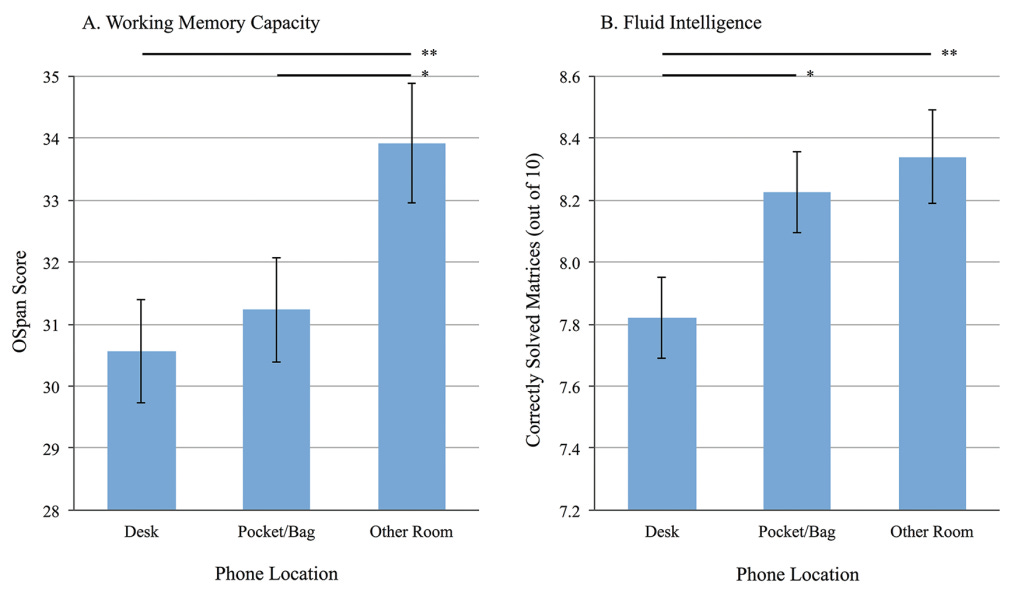
Yet cognitive capacity still dropped.
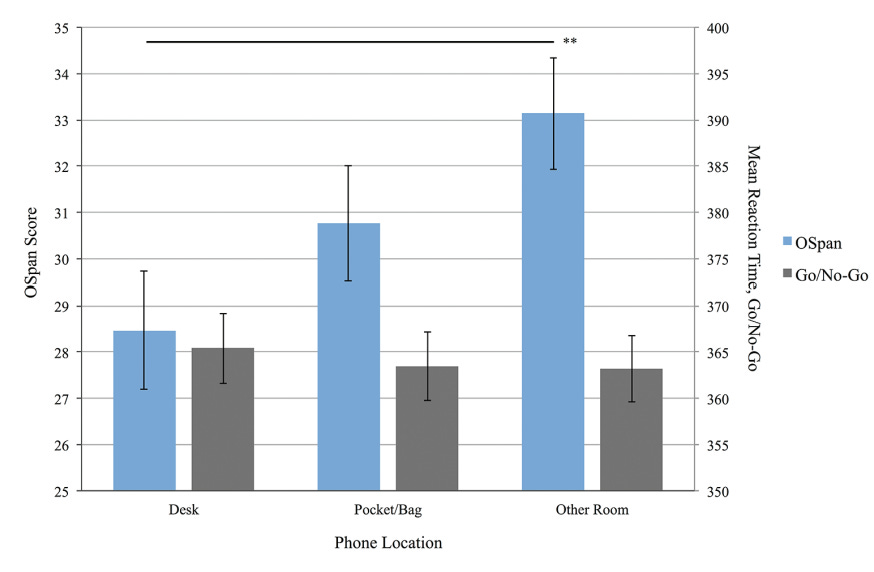
The effects showed up on both memory test & reaction time measures. These were significant impairments in critical cognitive functions.
Why “Face-Down” Is A Myth
Your brain operates like computer RAM with limited cognitive resources. When your phone is close by, a portion of that RAM gets allocated to not thinking about it. This is the idea of attentional resource allocation.
It’s not conscious. You’re not sitting there actively resisting the urge to check 𝕏 or Instagram. But your brain’s executive control system is working in the background spinning to suppress the automatic attention response to a salient object in your environment.
The same suppression happening runs on cognitive horsepower. Resources that would otherwise be allocated for the actual task you’re working at.
Skowronek et al. (2023) confirmed this: people processed information 9% slower when phones were present versus absent.
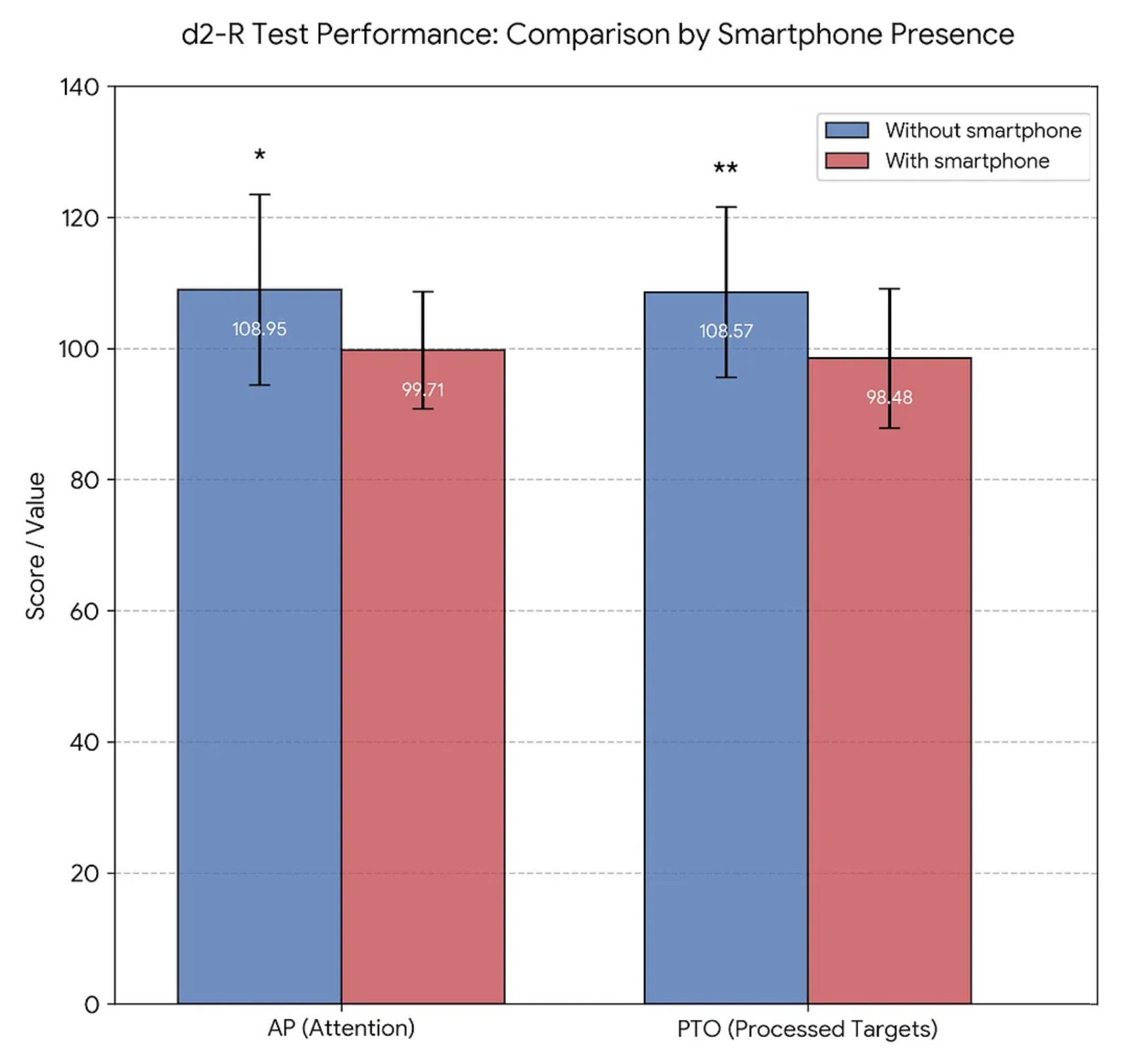
It’s an invisible cognitive tax. Every moment your phone is within spitting distance, you accept operating at a diminished cognitive potential.
The Addiction Multiplier
This same effect even scales with phone dependency.
Those with higher levels of dependence had a much larger cognitive impairment from phone presence. If you’re someone who checks your phone more than 186 times per day (yep…that was the new average in 2025), the attention tax is even greater.
People in the top third of dependency scores showed significant performance hits even when their phones were in their pockets. Low-dependency users needed to keep the phone out of sight and that was enough. But high-dependency users needed complete spatial separation for restoring full cognitive capacity.
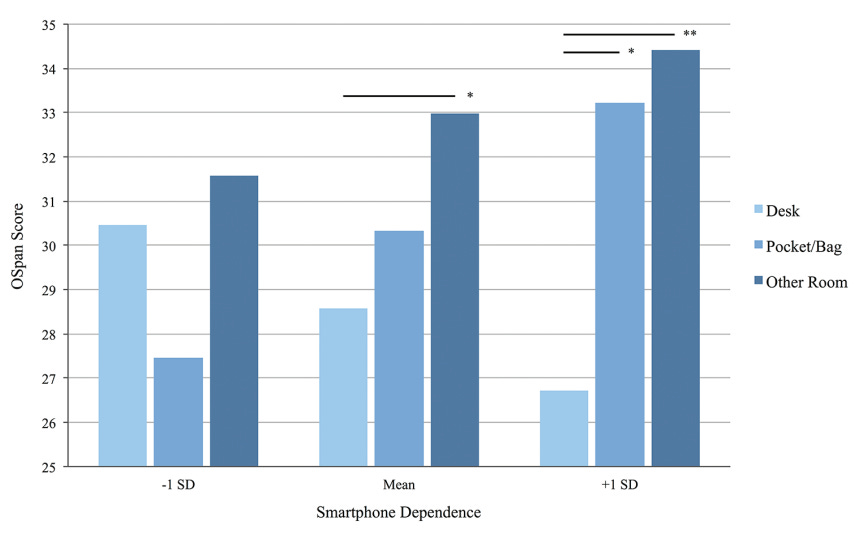
The digital cycle looks something like this: more phone dependence → higher likelihood your phone is present → greater cognitive degradation → more likely to use your phone as a cognitive crutch → more phone dependence.
Rinse & repeat.
Your phone has trained your brain to allocate cognitive fuel to monitor its status. Even unconsciously when it’s “off”.
Beyond Productivity: The Human Cost
Cognitive tests are one thing, but the effect extends beyond that to human connection.
Przybylski & Weinstein (2012) studied face-to-face conversations with smartphones present vs. absent again. When a phone was visible on the table, strangers who were asked to have meaningful conversations reported significantly lower relationship quality, less closeness, & less trust.
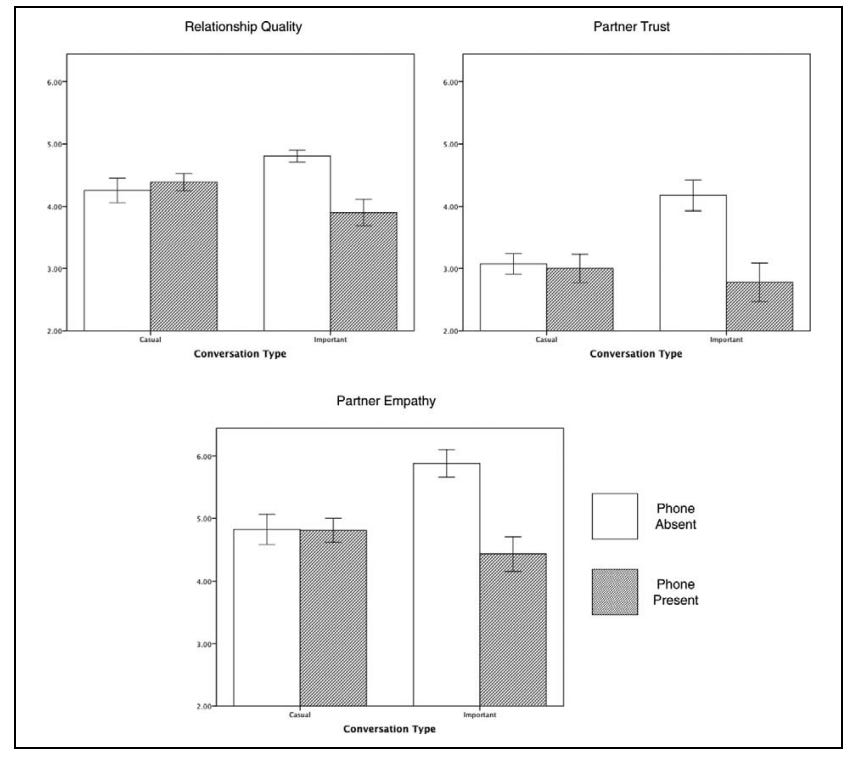
While the effect was present for casual conversations, it was even more pronounced when the topics were deemed meaningful.
The Simple Solution
In keeping with our theme, we’ll opt for the intelligently-designed system over any sheer willpower method. Each & every time.
A vote to abstain from the cheap dopaminergic source is a vote for a more focused you. A more powerful cognition built to last decades.
The solution is simple, but not easy (at least at first to break the dependency): reduce the friction to focus & increase the friction to distraction.
If you can sit with momentary boredom or uncertainty without reaching for stimulation (a subtle sign of elite health), you've built the cognitive capacity modernity systematically erodes.
Defeat the distraction epidemic one microhabit (microvictory) at a time.
You don’t “lock in”.
You don’t magically become focused.
You train to become focused like you would for building aerobic capacity or strength. Through progressive adaptive overload & environmental design.
For more on developing the top 1% focus, check out the below where we built a system that’s working for many:

Train your focus like your future depends upon on it. Because it does.
Dial in,
Phys
In the midst of reducing the dependency right now. Got one of those app/notification blockers and it’s eye opening the impulse to grab and check random things, but then you feel the resistance that you actually can’t because it’s blocked.
100% agreed my mind feels less of a pull when the phone is away in a separate room, but when I need the phone close by for calls, the fact my mind knows I can’t use it for entertainment has helped a lot mentally.