


We’ve always known there was something more going on.
For years we explained ultraprocessed food’s neurohormonal chokehold on us with reductionism.
It tastes better.
We eat it faster.
It doesn’t satiate us.
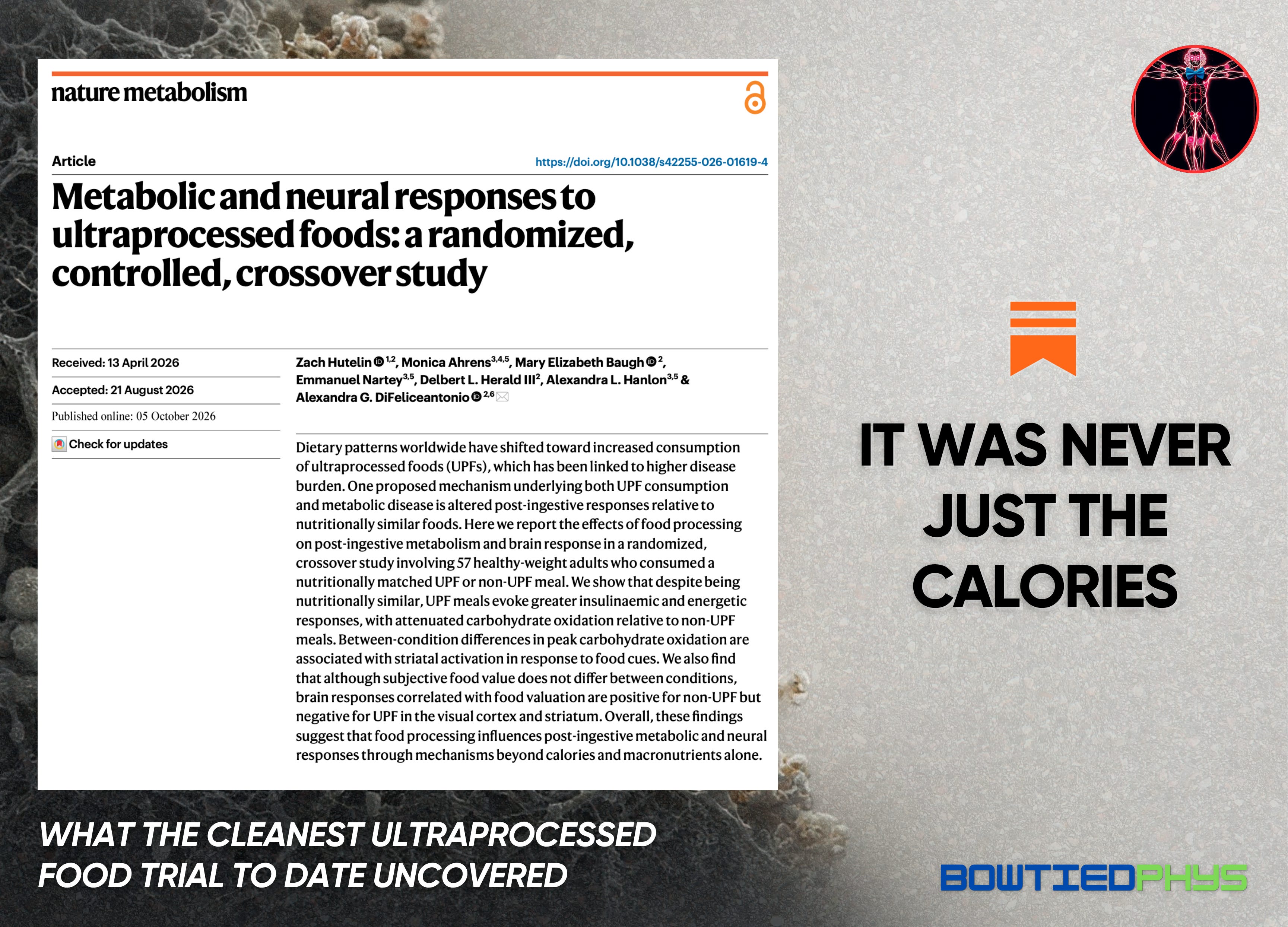
Last week, a Virginia Tech team finally published one of the cleanest ultraprocessed food experiments taking this regurgitated logic off the table.
The 30-Second Version
Setup: Two 300-calorie meals. One ultraprocessed & one whole-food, matched within ~2% on 12 different nutritional variables.
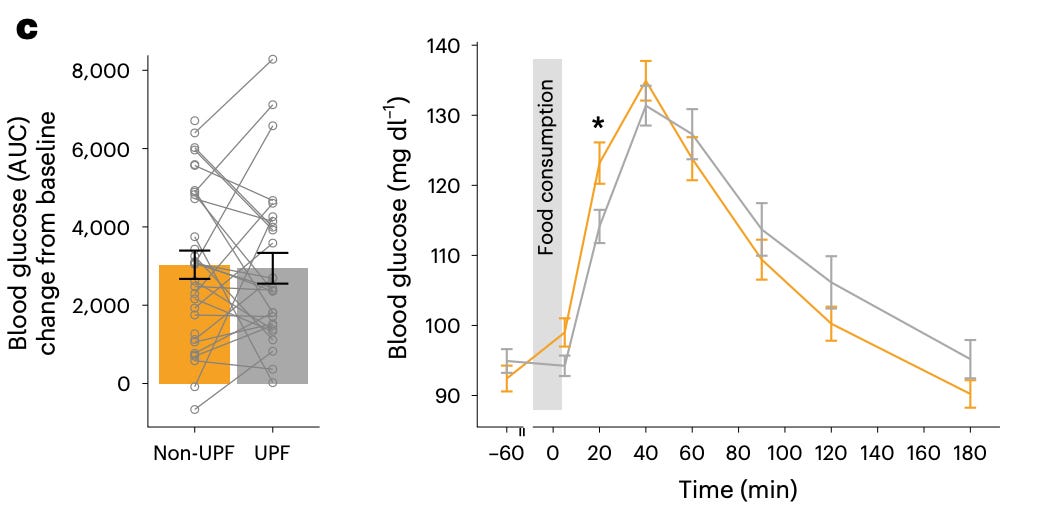
Glucose: Identical across the 3 hours.
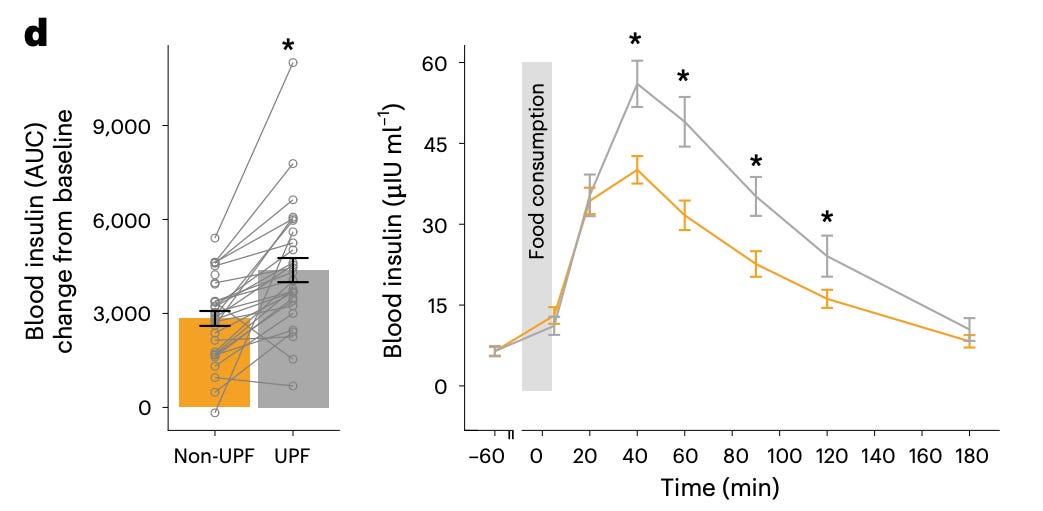
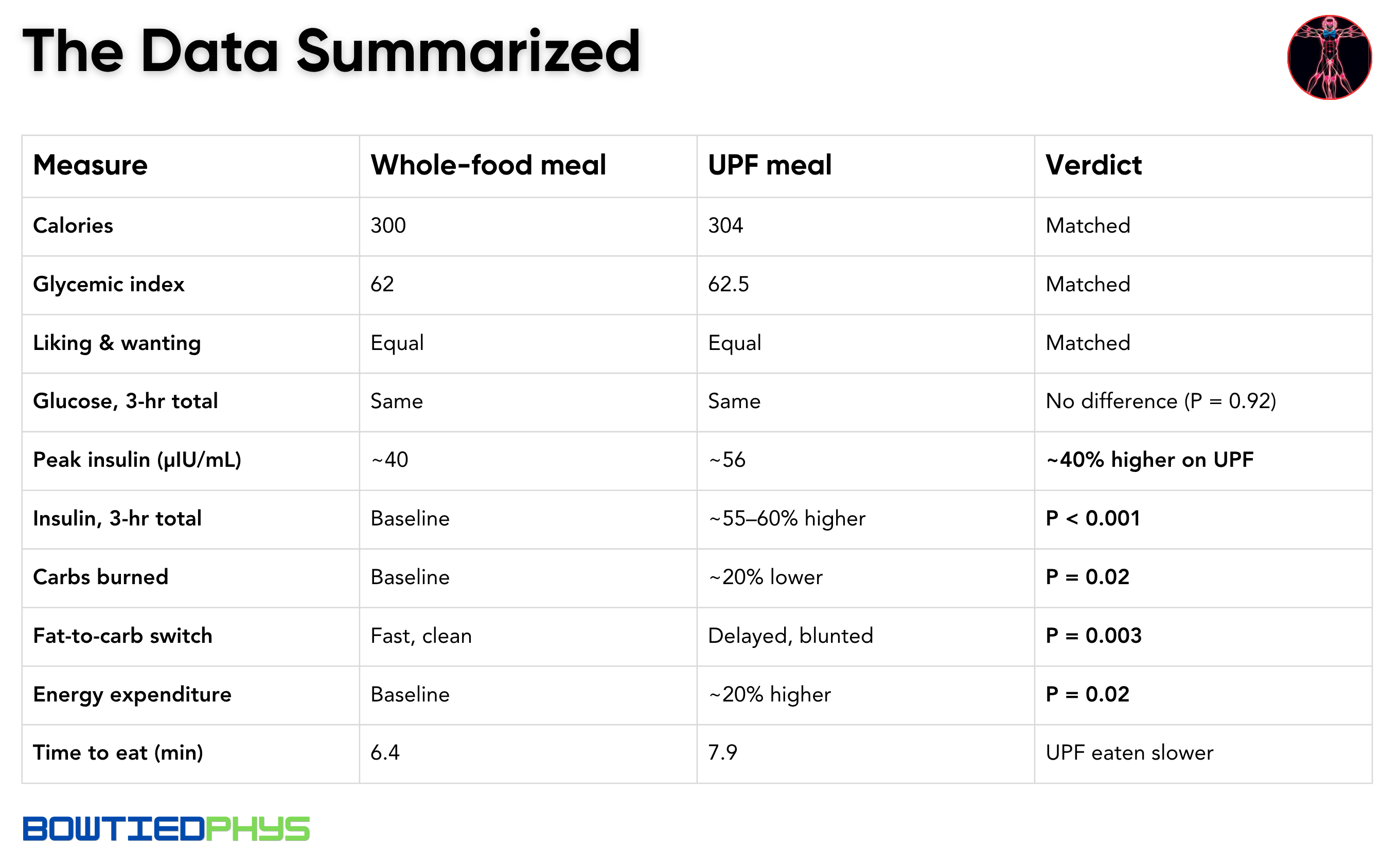
Insulin: 60% higher after the UPF meal with a ~40% higher peak
Fuel burning: The UPF meal blunted the switch from fat to carbs. 20% fewer carbs were burned despite more insulin.
Brain: The bigger someone’s metabolic disruption, the stronger their reward-center response to UPF food pictures.
Value: People bid the same money for both food types, but their brains encoded value in opposing directions.
Two Different Meals with the Same Label
The researchers took 57 adults whose typical diets consisted of ~55% ultraprocessed calories (exactly the US average).
Every morning, each individual consumed both meals inside a sealed room that measured every breath for 4 hours to track what fuel substrate the body was using. Blood was drawn 8 times and they also did an fMRI brain scan.
What were the two meals?
Whole food meal: hard-boiled eggs, banana, cheese, dried cranberries, sea salt
UPF meal: deli turkey, instant mashed potatoes, chocolate chip cookie, frosted wheat cereal, veggie chips, white bread, PB&J
The cool part about this was they matched the two meals within 98.4% on 12 variables: weight, calories, energy density, carbs, available carbs, fat, protein, glycemic index, glycemic load, fiber, sodium, & water.
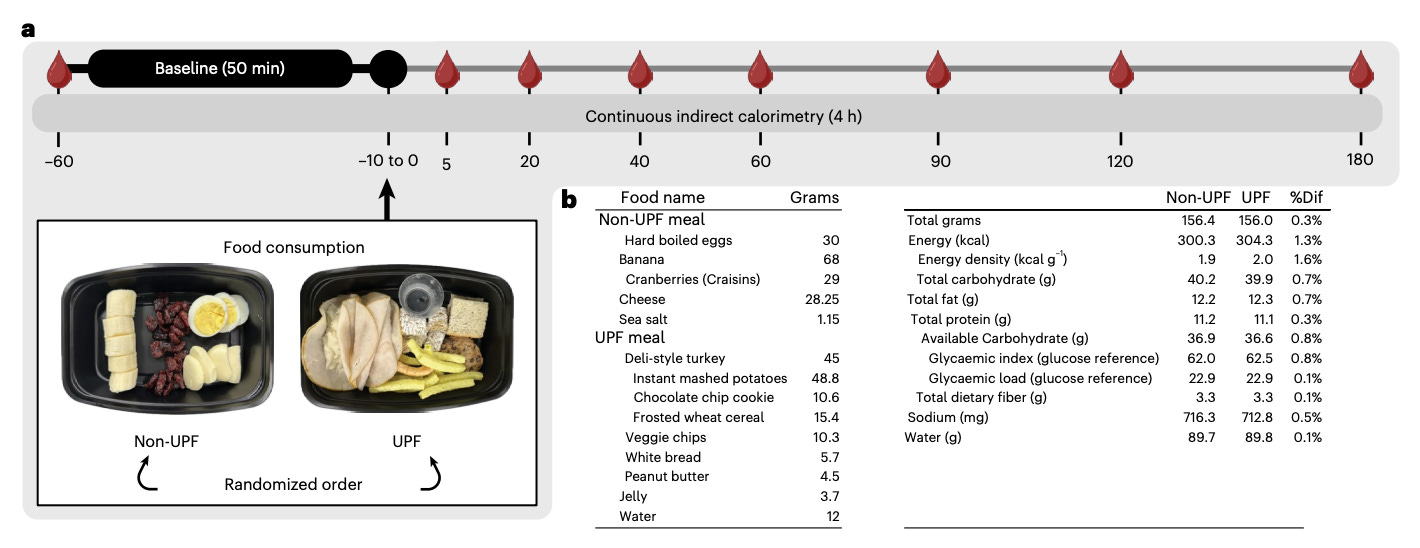
The cherry on top of why this was so well-designed. They even matched variables that are usually attributed to why hyper-palatable foods are more easily consumed:
Taste: Liking & wanting were identical.
Appetite: No differences in hunger or satiety at any point.
Eating speed: UPF meal was eaten slower.
The Post-Meal Responses
Minute 20: Blood glucose rose faster after the whole-food meal: 123 vs. 113 mg/dL.
Minute 40: Both meals peak around 130–135 mg/dL. Over the 3 hour testing period, total glucose exposure was identical.
But where it gets fascinating for us is with insulin.
The UPF meal peaked at 40% higher (56 vs. 40 µIU/mL), then stayed elevated at minutes 40, 60, 90, & 120. Overall insulin exposure was ~60% higher.
Both a clear signal of reduced insulin sensitivity.
Minutes 40–80: Elite functioning mitochondria are defined by metabolic flexibility & measured by the respiratory exchange ratio (RER).
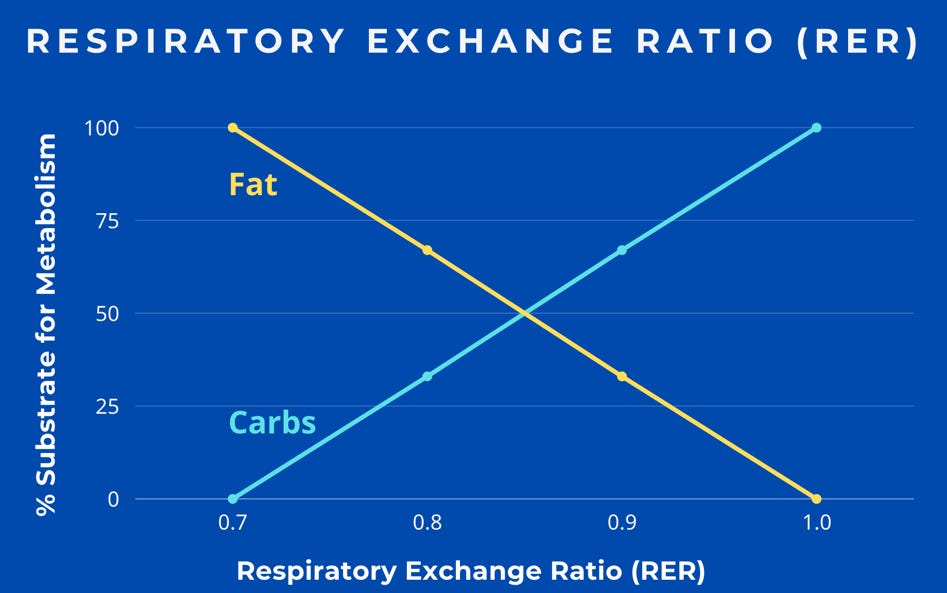
Simply stated: Someone who is metabolically flexible…when glucose hits their cells, it shifts from a fat burning preference to a carb burning one with minimal friction.
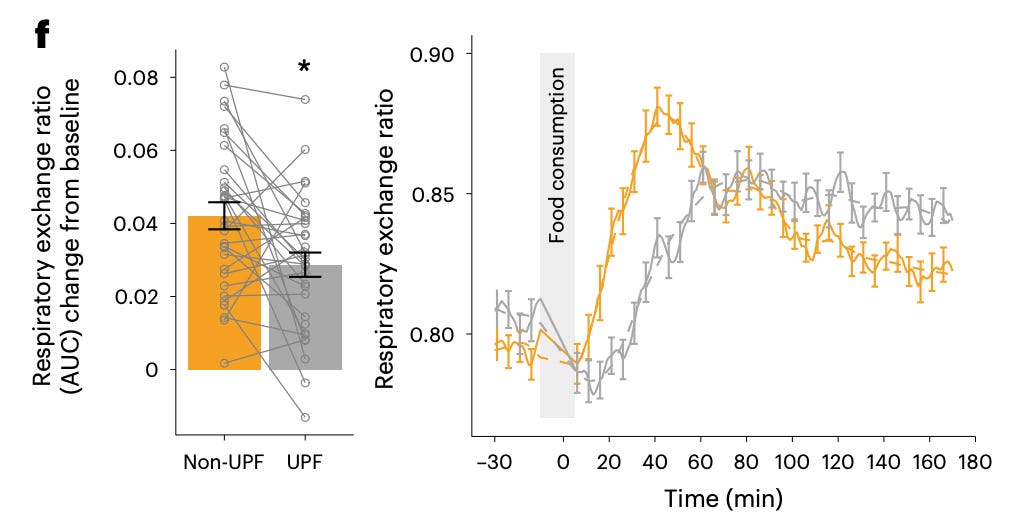
Whole-food meal: We get a clean pivot. RER jumps to 0.88 by minute 40. Fat burning drops 45% as the body shifts to carbs as the preferred fuel source (from 0.09 to 0.05 g/min).
UPF meal: A delayed, blunted pivot. RER peaks lower & later. Carb burning comes in 20% lower & fat burning stays steady.
Both meals viewed thru the lens of RER.
Both meals viewed thru the lens of carb & fat oxidation.
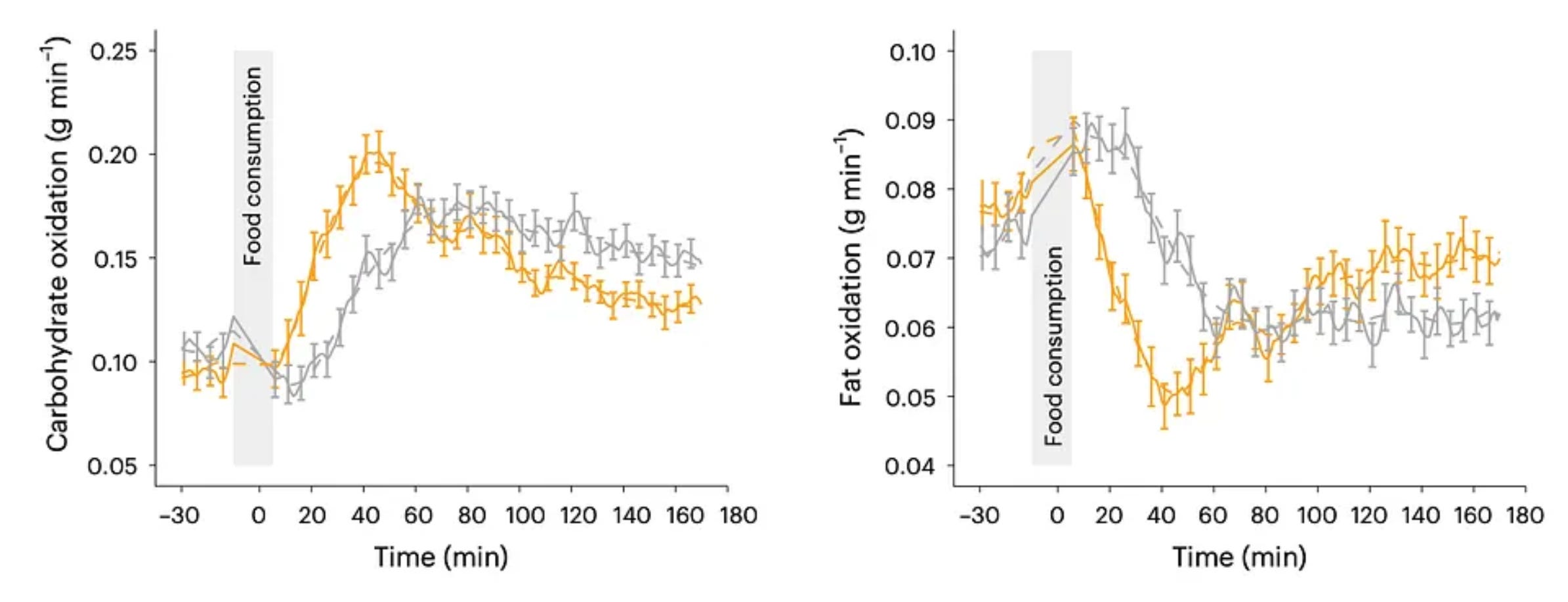
So when we put it altogether: More insulin → fewer carbs burned → incoming glucose not being used as fuel → being pushed toward adipose storage instead
Why It Happens
“Many UPF products, despite being eaten as solids, are formulated to transition quickly into a lubricated, semi-fluid bolus...manufacturing techniques are primarily intended to optimize the oral sensory experience; however, they may unintendedly also influence digestion kinetics & downstream metabolic responses, such as the observed higher insulinaemic response but similar peak blood glucose levels.”
— Hutelin et al., Nature Metabolism (2026)
Most forms of hyperpalability engineering can be summarized like this.
UPFs soak up saliva fast. Combine carbs with fats that lubricate everything into a smooth, fluid-like mass before you swallow.
Most absorption & gut-to-brain signaling happen while it’s already halfway digested.
So you get a gut-brain axis that’s hacked: the same nutrients with a different delivery speed & different neurohormonal response.
How Gain Happens in the Brain
As Big Food continues their hunt for vectors to outmaneuver our neurohormonal signaling, especially in the GLP-1 mimetic era, it’s worth spending a minute on flavor-nutrient learning.
It’s the idea that the brain learns what a food is worth partly from what happens after you eat it. Nutrient signals go from the gut to the the brain’s reward center (striatum). Over dozens of meals, these signals program you with the foods you want.
Finding #1: The bigger the metabolic hack, the stronger the pull toward UPFs.
Those with the largest gap in carb burning between the two meals had relatively stronger reward responses to pictures of ultraprocessed foods.
Simply stated: The more a UPF meal distorted someone’s fuel metabolism, the more their reward circuitry tilted toward UPF cues.
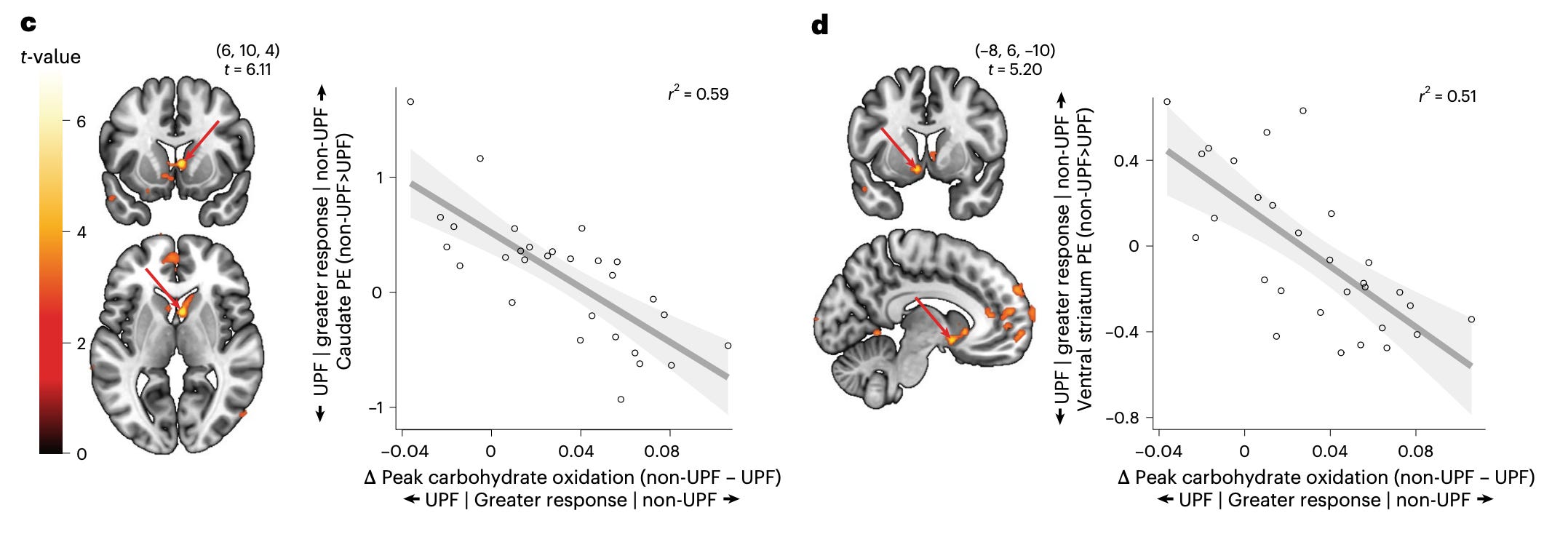
Finding #2: Processing alone (nutrients held constant) shifted how the brain computes food value.
When the subjects were asked to bid real money on 28 foods, what they submitted were nearly identical: $2.85 for whole foods vs $3.05 for UPFs.
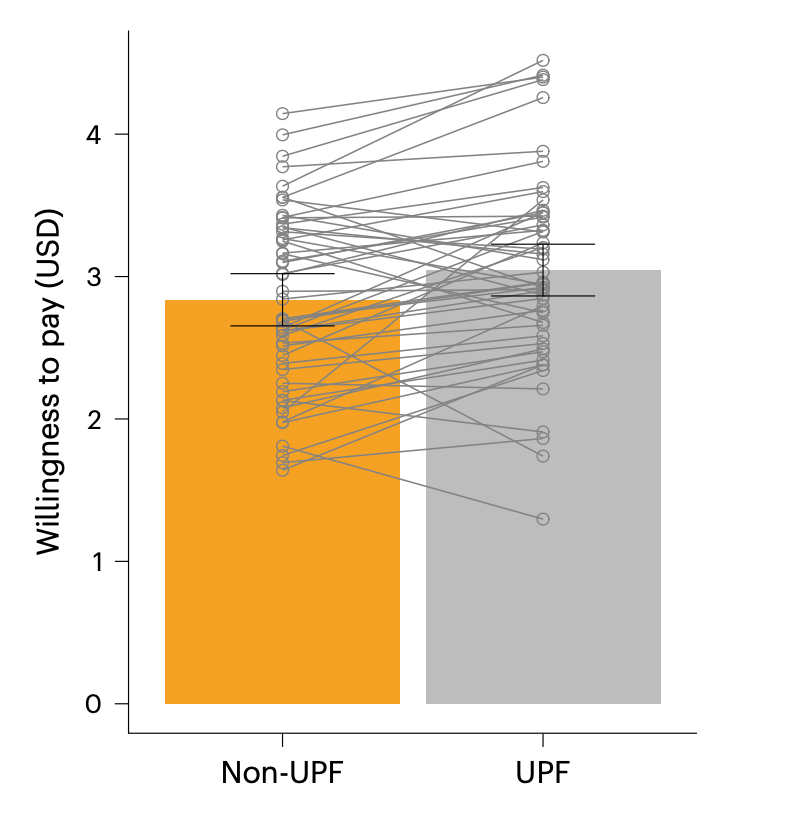
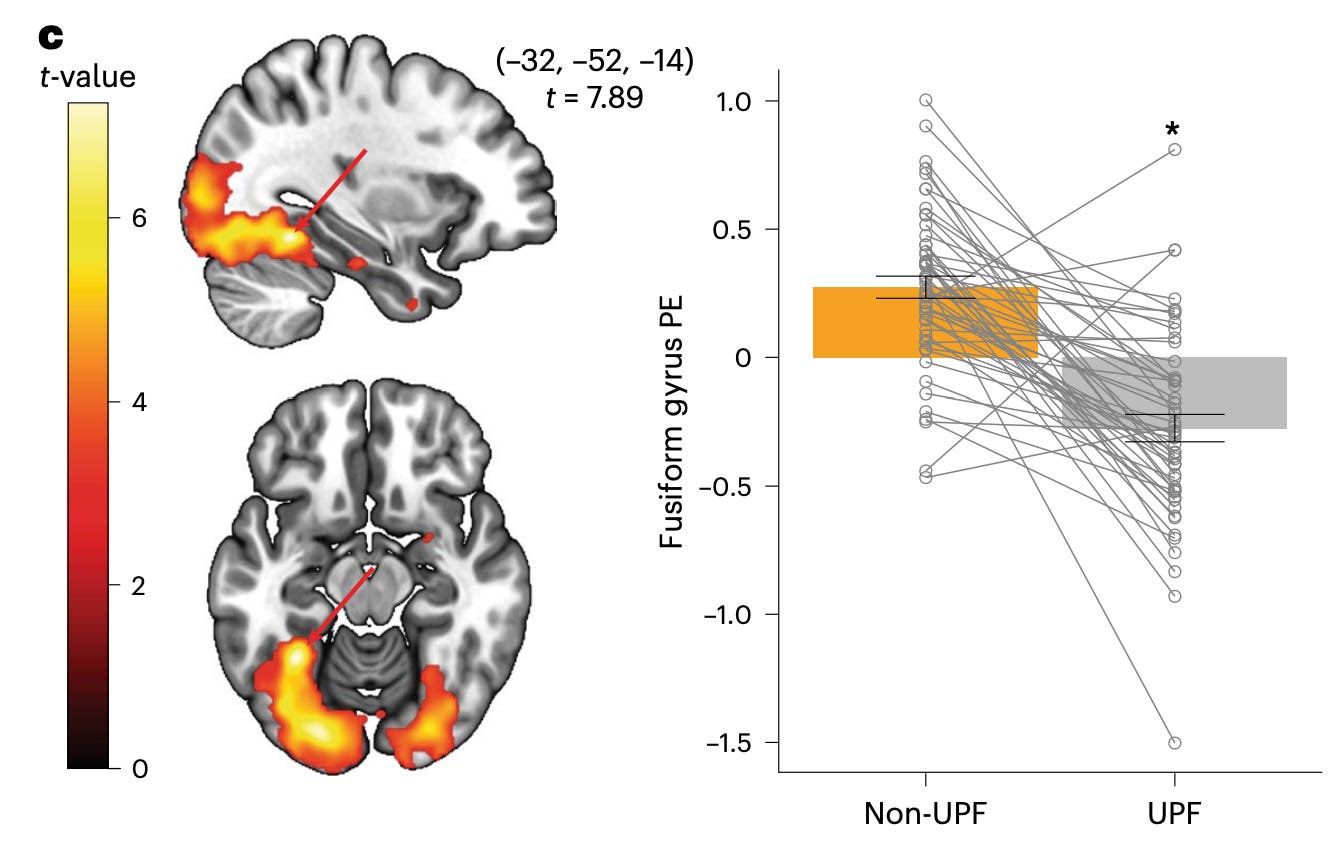
But their brains disagreed. In the fusiform gyrus, value went in opposite directions:
Whole foods: more brain activity + higher bid
UPFs: more brain activity + lower bid
The fusiform gyrus houses the brain’s fusiform food area → a brain region governed by glucose, insulin, & ghrelin.
Practical Takeaways
Environment is king: To clean your pantry & fridge is to clear the food noise. Route your walks away from the craving spots. Raise the barrier to the vice.
Think past macros alone:
IIFYM was always a misleading, nuance-deficient nutritional strategy.
The soft food diet has done much more than hijack our palettes. It’s also altered our maxilofacial structure. A good heuristic at this point: If a food dissolves with barely any chewing (puffed, extruded, crisped, instant), it’s partially pre-digested & disadvantageous to the entire metabolic conversion process.
Always contextualize: Glucose was identical in the study. But now you know insulin ran 60% higher. If you were to throw on a Dexcom CGM and test yourself, you’d never pick up on this. Point here is to add fasting insulin & track ALL metabolic biomarkers to your bloodwork.
Hands-down the highest quality study we’ve had in this area since Kevin Hall & his team locked people in an NIH ward in 2019.
With a little more understanding on how food engineering (hijacking) happens, we can program our own systems & environment to be a little harder to hack.
Stay vigilant and stay after it.
See you guys next week.
— Phys