


The Phys Debrief · #02
Practical takeaways & the latest research from the health space’s most valuable long-form content, without the rest.
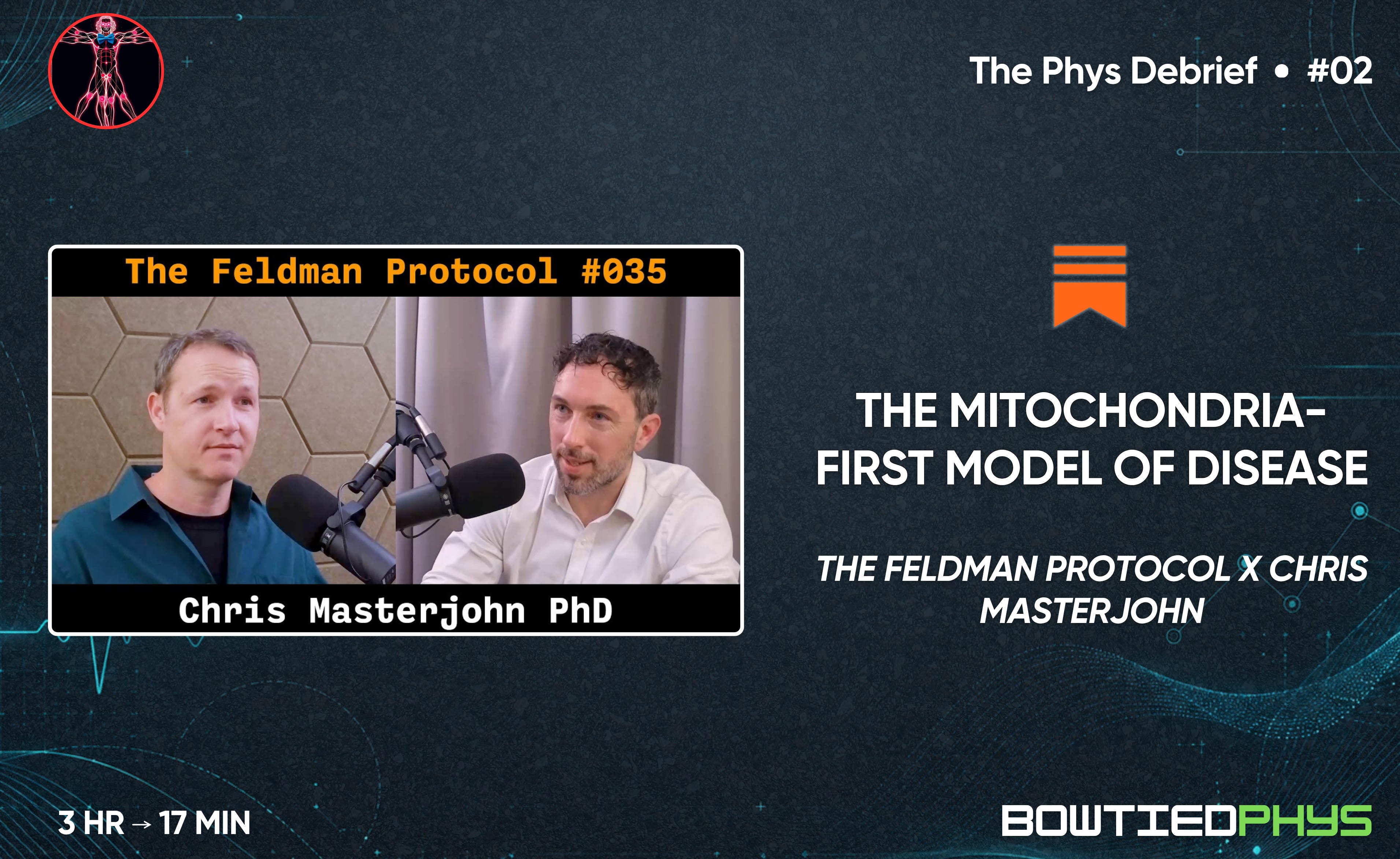
No serious metabolic health discussion can happen without an emphasis on the information processes of the body: mitochondria.
Right now, there’s no better individual to hit this topic than Chris Masterjohn, who runs the mitochondrial testing company Mitome and has spent 20+ years on the biochemistry of nutrition.
Masterjohn’s underlying thesis: mitochondrial energy production is what builds, maintains, repairs, and moves everything in the body.
Dave Feldman, the engineer behind the lipid energy model and the keto-CTA trial, hosted a dense one released earlier in the week. One we’ve made as digestible & practical as possible and extracted a plethora of hidden gems in here from both of these guys.
Contents:
In 1 Sentence (30 sec)
In 250 Words (1 min)
Practical Takeaways (4 min)
Episode Blueprint (11 min)
Where to Listen & Watch (30 sec)
In One Sentence
Mitochondrial energy production is the upstream determinant of most health and disease because nearly every cellular process that protects you (clearing cholesterol into cells, activating immune cells, defending membranes from oxidation) is an active, ATP-dependent process, which reframes high LDL, plaque, seed-oil damage, and even inflammatory disease as downstream symptoms of bottlenecks in energy metabolism rather than primary causes.
In 250 Words
The organizing lens is that movement implies energy. The LDL receptor pulling cholesterol into a cell, a T-cell activating to kill cancer, an endothelial cell chaperoning a lipoprotein across its wall — all are active processes powered by ATP from the mitochondria. Treat mitochondrial function as the root system and most “diseases of high markers” look different.
On atherosclerosis, Masterjohn and Feldman largely converge: native LDL concentration is not the primary driver. Damage to the particle is. Oxidation of polyunsaturated fats in the LDL membrane, and the LDL aggregation that follows, is what drives macrophage uptake and plaque. Plaque is framed as a containment response, dynamic and at least partly reversible if you remove the conditions that created it.
This is why seed oils harm. Their polyunsaturated fats are an oxidative liability: they load your membranes and lipoproteins with the fatty acids most vulnerable to peroxidation, and aging guarantees the oxidative stress. The only two long-term, large, double-blind RCTs ever run point toward harm for heart disease and cancer.
A second theme runs throughout: research is mostly broken. Short trials get extrapolated to long-term claims, “linked” hides whether an effect went up or down, peer review is single-blind theater, and trials stopped early for benefit exploit regression to the mean.
Practical bottom line: support the mitochondria first, minimize the most oxidizable fats, and treat dramatic short-term findings as likely to shrink.
Practical Takeaways
Mental Models (first principles)
Treat movement as a tell for energy demand: If a biological process requires movement, whether pulling cholesterol into a cell, activating a T-cell, or transporting a vitamin, it requires ATP, which means it depends on mitochondrial function. Use this as a default lens: when a marker is off, ask what energy-dependent process upstream might be the bottleneck.
Read diagrams as snapshots of dynamic processes, not static endpoints: Most bad mechanistic reasoning treats a textbook figure as the final state. Molecules have a distribution of kinetic energy and interact stochastically; what goes into a space (an oxidized LDL particle in the artery wall) can also come back out. Assume reversibility by default.
Calibrate your confidence to the evidence and say so out loud: Distinguish wild speculation from mechanism from observational association from RCT, and label which one you’re standing on. The failure mode in nutrition is using vague language to smuggle a causal claim you won’t defend openly.
Expect dramatic short-term findings to shrink (regression to the mean): A huge effect in a first or short study is usually supplanted by less impressive results later, and the larger the follow-up, the smaller the effect. When you see something dramatic, your base case should be that it gets less dramatic with more data.
Atherosclerosis & the lipid debate
Target particle damage, not just particle count: The model both experts converge on is that oxidation of polyunsaturated fats in the LDL membrane, and the LDL aggregation it promotes, drives macrophage uptake and plaque — not the native LDL concentration itself. Lowering oxidizable substrate and oxidative stress is the lever, not chasing the number in isolation.
Mind your saturated-fat-to-choline ratio: Phosphatidylcholine is the primary anti-aggregation molecule on the LDL particle and is fully dependent on dietary choline, an essential nutrient. The more saturated fat in the diet, the more choline you need — a driver Masterjohn has long tied to fatty liver as well. Egg yolks and liver are dense choline sources.
Don’t throw out coronary calcium, but know its limit: The calcium that shows up on a CAC scan is macro-calcification, which is relatively stabilized. The micro-calcifications that make a fibrous cap brittle and rupture-prone don’t show on imaging. CAC can correlate with the process without being the thing that determines whether a plaque breaks.
Plaque progression is largely driven by existing plaque: Once you have plaque you tend to get more, but mainly because the conditions that created it are still present. Remove those conditions and the animal literature supports regression. Plaque is a situational best-effort response, not a one-way ratchet.
Seed oils & PUFAs
Treat seed oils as an oxidative liability, not an acute poison: Their polyunsaturated fats don’t damage you on contact. They make your membranes and lipoproteins more vulnerable to oxidative damage that aging then guarantees. The “house of glass” framing: fine until something throws a stone, and aging always eventually throws stones.
It’s the bis-allylic carbon, so PUFAs are the real exposure: The carbon sitting between two double bonds is what’s highly vulnerable to peroxidation, which is why polyunsaturated (not monounsaturated) fats carry the liability. You still need essential PUFAs in small amounts. The problem is high chronic intake, not their existence.
If you eat something daily, make it the highest-quality fat you can: Masterjohn’s practical heuristic on the “dose makes the poison” question — occasional canola in a salad dressing is trivial, but anything that becomes a base fat in your daily diet should not be a seed oil. The harm is a function of chronic membrane loading over years.
Weight your evidence toward long, large, blinded trials: The short trials (8–12 weeks) tend to show metabolic benefit from seed oils. The multi-year trials trend neutral-to-harmful for heart disease and increased for cancer. When short- and long-term data conflict in nutrition, the long-term data wins.
Biomechanics, longevity & inflammation
Train movement quality, not just cardio, for longevity: Cardiorespiratory fitness is real but probably overweighted. Elite athletes in sports demanding excellent joint function and biomechanics (pole vault, gymnastics) outlive the population by ~8 years versus ~2–3 for runners/cyclists. The hypothesis: high-quality biomechanics and extracellular matrix may support both immune surveillance against cancer and resistance to inflammatory disease.
For Crohn’s, internal vs. external pressure is an underrated axis: A leading genetic driver is PIEZO1, a pressure receptor. Track with travel to altitude (lower external pressure) and the Ensure-based liquid diet works partly by reducing intestinal pressure. If you or someone you know manages IBD, the pressure dimension is worth raising with a clinician alongside diet.
Breastfeeding duration tracks lower Crohn’s risk: The meta-analysis shows a dose-dependent protective association, strongest at the longest durations. Crohn’s is also strongly associated with a country’s degree of industrial development — close to non-existent before the modern food environment.
Personalization & supplements
More CoQ10 is not better — there’s a dose ceiling: RCTs show ~100–200 mg/day modestly improves glucose and blood pressure, but past that the benefit reverses and markers can climb above baseline. Don’t megadose by default. The dose-response is an inverted U for most people.
Use whole-genome sequencing over SNP chips for genetics: Masterjohn would only use whole genome sequencing for findings like COMT, not consumer SNP arrays. If you’re making decisions off genetics, the data quality of the underlying test matters more than the report.
Reference point — Masterjohn’s own daily stack: 8 g creatine, 600 mcg molybdenum, 600 mcg K2, 100 mg CoQ10 as ubiquinol, a food-based vitamin C, plus ~100 g strawberries daily for additional vitamin C. Diet is beef and organs (liver, kidney, heart), eggs, dairy, some rice/corn tortillas/potatoes, olive oil — ~150 g net carbs, ~160 g protein. A data point, not a prescription.
Episode Blueprint
[00:00:00–00:10:00] Mitochondria as the root: ATP is the currency
Key Points
Mitochondrial testing (Mitome) uses a cheek swab to read enzyme-complex patterns and ratios, flagging nutritional bottlenecks — e.g., a methylation-limited pattern (B vitamins, MTHFR) or a specific need for a nutrient like riboflavin or CoQ10.
The reframe: even raising LDL receptors is an ATP-dependent process. The receptor capturing an LDL particle and moving it into the cell runs on motor proteins, chaperones, and cytoskeletal transport — all powered by ATP hydrolysis.
ATP is a cellular currency with a variable “exchange rate,” but every active process carries an ATP cost. Mitochondrial output funds the production, maintenance, repair, and distribution of everything in the body.
Action sits on two layers:
Universal basics (nutrition, exercise, sleep, sunlight, stress) that support all mitochondria
Idiosyncratic layer unique to your genetics, history, and current diet.
“You don’t need to know the molecular biology to know right off the bat that if it requires movement it requires energy.”
— Chris Masterjohn
[00:10:00–00:21:00] Long time horizons, short-term miracles, and the limits of exercise knowledge
Key Points
Optimize mitochondrial health on long horizons by default, but short-term “miracles” happen. One early Mitome customer with a CoQ10 bottleneck regained her period after 10 years of absence following targeted high-dose CoQ10.
CoQ10 has a dose ceiling: ~100–200 mg/day helps glucose and blood pressure. Higher doses lose the benefit and can push markers above baseline.
Our knowledge of what the average person should do for health is weakest exactly where it matters most. Elite-sport performance is well-characterized. Everyday human health optimization is not.
Cardiorespiratory fitness is critical but likely overrated for longevity. The biggest lifespan gains cluster in sports with excellent biomechanics and joint function, not pure endurance.
Studies referenced
Sport and longevity: an observational study of international athletes (GeroScience, 2024; Altulea et al.) — across ~95,000 athletes, male pole vaulters (+8.4 yrs) and gymnasts (+8.2 yrs) showed the largest lifespan extension while volleyball and sumo were negative; observational data.
[00:21:00–00:33:00] Biomechanics, the extracellular matrix, cancer & Crohn’s
Key Points
Masterjohn’s brainstorm (explicitly hypothesis, not data): T-cell activation is energy-intensive and partly fueled by kinetic energy generated as the cell pushes off the extracellular matrix. Cancers can remodel that matrix to sabotage activation, so matrix quality maintained by good biomechanics may support immune surveillance.
Population death structure runs in sequence: heart disease first, then cancer, then a diverse set of neurological/neurocognitive diseases as affluence and age advance. Larger longevity benefits imply protection drifting toward cancer and neurological disease.
Crohn’s is reframed around pressure. The Ensure-based liquid diet rivals top biologics partly by lowering intestinal pressure. A main genetic driver is the pressure receptor PIEZO1. Flares track with travel to altitude (reduced external pressure).
Cancer (pathologically anti-inflammatory: it evades the immune response) and Crohn’s (pathologically pro-inflammatory: it can’t resolve) are framed as opposite failures of the same pressure-and-inflammation regulation.
Studies referenced
High altitude journeys and flights are associated with an increased risk of flares in inflammatory bowel disease patients (Journal of Crohn’s and Colitis, 2014; Vavricka et al.) — IBD patients experiencing flares had more often traveled above 2,000 m or flown within four weeks; matched case-control observational data.
[00:33:00–00:37:00] Crohn’s, development & breastfeeding
Key Points
Crohn’s was probably near non-existent before the modern food environment. One of the strongest country-level associations is degree of industrial development, with a roughly 62-fold incidence difference cited between America and the Caribbean.
Ecological data can’t establish individual causation but can flag what’s constant in a society — here, ultra-processed food exposure.
Breastfeeding shows a dose-dependent inverse association with Crohn’s risk, strongest at the longest durations.
Studies referenced
Systematic review with meta-analysis: breastfeeding and the risk of Crohn’s disease and ulcerative colitis (Alimentary Pharmacology & Therapeutics, 2017; Xu et al.) — pooled analysis found ever-breastfeeding lowered Crohn’s risk (OR 0.71), with the strongest reduction at ≥12 months duration; observational meta-analysis.
[00:37:00–00:48:00] Paleo vs. Weston Price, and the war on the word “linked”
Key Points
Masterjohn came up paleo-adjacent but from a Weston Price lens: Price focused on what went wrong in the industrial revolution, paleo on the agricultural revolution. He locates the bigger harm in industrialization.
His read on the agricultural transition: early populations adopted a single crop badly, hit nutrient deficiencies and stunting, then learned their way back to balance. The harm was the naïve implementation, not grain itself.
The shared methodological obsession: the word “linked” should be purged from science because it hides both direction (did the thing go up or down?) and whether causation is being implied. An abstract should let you know the author’s view of the main findings without reading the full paper.
The deeper problem is double-speak: researchers run studies because they want causal answers, then use vague language because they feel barred from claiming causation.
[00:48:00–00:58:00] Why peer review fails as a guardrail
Key Points
Nutrition observational studies often use confirmatory, causal-sounding language while burying “exploratory” once or not at all — the Stanford twin (vegan) study is cited as an example of confirmatory framing.
Peer review is described as largely theater: authors are incentivized to find a reviewer credible enough to satisfy an editor but not expert enough to mount a strong critique. Reviewers are unpaid and incentivized to do the minimum.
Most journals don’t put a statistician on stats-heavy papers or a causal-inference expert on causal claims, so the “guardrail” depends on reviewers who often aren’t the right experts.
Both favor transparency: single-blind review is the worst of all worlds because it lets reviewers retaliate while authors stay blind. Either fully open or double-blind would be better.
[00:58:00–01:17:00] The lipid model: oxidation, transcytosis & vitamin E as host defense
Key Points
Feldman has long argued LDL particles don’t passively seep through healthy endothelium. The tight junctions are too tight and blood flow doesn’t favor it. Active transcytosis (notably via SR-B1) carries even unmodified LDL across — the field’s 2020 EAS consensus shift toward transcytosis is cited.
Masterjohn agrees transcytosis matters and adds that branch points with disturbed flow and higher mechanical/shear stress are where atherosclerosis concentrates and where larger particles can cross — consistent with more endothelial damage and immune activity there.
Both frame apoB-containing lipoproteins as part of the innate immune response. Vitamin E (alpha-tocopherol) protruding from the lipoprotein monolayer is read as host defense, not merely the particle’s own antioxidant — though Masterjohn notes vitamin E is also simply transported there.
Familial hypercholesterolemia genetics were historically associated with lower mortality before the decline in infectious disease, supporting a quantitative trade-off: FH-range LDL is pro-heart-disease but may have been protective against infection.
[01:17:00–01:36:00] Familial hypercholesterolemia, Brown & Goldstein, and what’s really driving plaque
Key Points
Monogenic FH carries atherosclerosis risk beyond what LDL level alone predicts (hazard ratios cited near ~2.0 for monogenic vs. ~1.3 for polygenic at matched LDL) — the steel-man counter is lifetime area-under-the-curve and in-utero exposure.
Masterjohn’s position: the LDL-receptor impairment, not the native LDL concentration, drives atherosclerosis — by increasing particle residence time → modification → plaque.
Feldman’s added layer: macrophages in the subendothelial space take up both modified and unmodified LDL as part of an immune response, and inflamed endothelium transcytosing more apoB lipoproteins is part of the innate-immune “dog pile.”
Key area of friendly disagreement: whether stopping inflamed endothelium from transcytosing unmodified LDL would matter. Feldman thinks yes (part of the immune playbook); Masterjohn is more agnostic on magnitude.
[01:36:00–01:48:00] Plaque as dynamic and reversible
Key Points
Both reject the “one-way ticket” view where a bound, modified lipoprotein simply traps a macrophage forever. By default everything is dynamic: what gets in can leave; binding affinities aren’t infinite.
Mechanistic speculation gets a bad reputation mainly because people do it badly. Treating static diagrams as reality and forgetting basic chemistry (kinetic-energy distributions, stochastic interactions).
Atherosclerosis is hard to study because it plays out over long horizons in a space you can’t easily film. Induced animal models often overwhelm the immune response in ways that don’t reflect everyday low-level plaque management.
The early-20th-century animal literature found that removing the cause of atherosclerosis let lesions regress on their own — atherosclerosis as temporary and dynamic.
[01:48:00–01:57:00] The keto-CTA study and its fallout
Key Points
The keto-CTA trial scanned lean mass hyper-responders on a ketogenic diet with very high LDL/apoB. Two headline findings: baseline plaque predicts future plaque progression. There was no meaningful association between LDL/apoB and plaque progression (R-squared near .01–.015).
Feldman states he requested withdrawal of the paper containing the Cleerly analysis and the journal accepted, with no objection from the analysis provider — he describes the dataset as anomalous. The non-Cleerly readings (semi-quantitative, Qangio, HeartFlow) are described as still supporting the original thesis.
More advanced statistics (minimal detectable change) imply only ~5 people in the cohort exceeded the noise floor for true progression vs. regression — consistent with a genuinely low-risk group and the reason a third (five-year) scan set is planned.
The bigger-picture argument: even a smaller re-recruited cohort with average LDL ~240–250 should show a signal if the simplistic version of the lipid hypothesis (high LDL, high risk, every population) holds.
Studies referenced
Plaque Begets Plaque, ApoB Does Not: Longitudinal Data From the KETO-CTA Trial (JACC: Advances, 2025; Soto-Mota, Norwitz, Feldman, Budoff et al.) — reported no association between apoB/LDL-C and noncalcified plaque progression in lean mass hyper-responders while baseline plaque predicted progression. Small single-arm longitudinal cohort. Since retracted at the authors’ request over methodological concerns affecting the data.
[01:57:00–02:16:00] Seed oils: the mechanism and the only two long trials
Key Points
The core problem with seed oils is that polyunsaturated fats are an oxidative liability, more vulnerable to peroxidation than any other macronutrient, rather than an acute toxin. The damage shows up as membranes and lipoproteins become more oxidizable and aging supplies the oxidative stress.
The vulnerable site is the bis-allylic carbon between two double bonds, which is why PUFAs (not MUFAs) carry the risk. Essential PUFAs are needed in small amounts. The liability is chronic high intake.
Short trials (8–12 weeks) show seed oils improving liver fat and metabolic control. Multi-year trials trend neutral-to-harmful for heart disease and increased for cancer. In nutrition, short-term benefit reversing over the long term is a recurring pattern (the SSRI-discontinuation difficulty over years is offered as a parallel).
The mechanistic trade-off even by the conventional lipid hypothesis: PUFAs lower liver fat and raise LDL-receptor activity, but enrich the LDL particle with exactly the fats that oxidize and seed plaque — a genuine double-edged sword, which is why long trials matter.
Studies referenced
A Controlled Clinical Trial of a Diet High in Unsaturated Fat in Preventing Complications of Atherosclerosis (LA Veterans Administration Trial) (Circulation, 1969; Dayton et al.) — a multi-year double-blind RCT where the high-PUFA group showed no mortality benefit and higher cancer incidence; one of only two long, large, blinded seed-oil trials.
Re-evaluation of the traditional diet-heart hypothesis: analysis of recovered data from Minnesota Coronary Experiment (1968-73) (BMJ, 2016; Ramsden et al.) — recovered-data reanalysis of a double-blind RCT showing linoleic acid lowered cholesterol ~13.8% but produced no mortality benefit and higher death per unit of cholesterol reduction; the second of the two long blinded trials.
[02:16:00–02:34:00] PUFA membrane loading, trial design & regression to the mean
Key Points
Diet can shift the fatty-acid composition of membranes, expanding the PUFA slice of the phospholipid “pie chart,” but the change is slow (years) and tissue-dependent — biggest in adipose triglyceride, more modest elsewhere, tightly regulated in the brain.
A hidden harm of chronic seed-oil intake: vitamin E gets diverted into expanding adipose stores, leaving less available to protect other tissues like skin.
Trials stopped early for benefit exploit regression to the mean — a dramatic early result is more likely luck than a durable effect. Stopping locks in the favorable snapshot. Masterjohn frames this as the same statistical principle behind “tall fathers have shorter sons.”
The longest seed-oil trial (LA Veterans, ~8 years) concluded its own duration was too short, since cancer incidence in the seed-oil group climbed most in years 5–7. The field then mostly produced 7–12 week trials.
“In general when you see large differences appear in a short time horizon you actually do observe mean reversion as the predominant long-term outcome.”
— Chris Masterjohn
[02:34:00–02:54:00] Research integrity, transparency & decentralized science
Key Points
Most research is described as a waste because scientists chase fundable, low-disruption questions rather than the most important knowledge gaps — “dancing around the edge” of existing recommendations to avoid rocking the funding boat.
Large trials are effectively never replicated given their cost, which raises the stakes on the objectivity and quality control of whoever runs and measures them.
Feldman’s stated path forward: decentralized, crowdfunded science with open code and open data, releasing everything so anyone (now aided by AI) can re-run analyses and surface errors quickly — how he says problems in the keto-CTA data were caught within 24 hours.
Political inertia around NIH funding is described as severe enough that meaningful reallocation would require Congress, which is partly why the open/crowdfunded route may move faster.
[02:54:00–03:00:00] Listener Q&A: defining food, diet & supplements
Key Points
On defining “food”: Masterjohn treats it simply as something edible and rejects equating “food” with “what I should eat” — there are foods you shouldn’t eat. Echoes Gary Taubes’ “food vs. food-like substances.”
His diet: beef and organs (liver, kidney, heart), 4–5 egg yolks/day, dairy including ~150 g heavy cream, some rice, corn tortillas, potatoes, vegetables, olive oil — ~150 g net carbs, ~160 g protein, ~2,800 kcal/day, all weighed out.
Supplements: 8 g creatine, 600 mcg molybdenum, 600 mcg K2, 100 mg CoQ10 as ubiquinol, a food-based vitamin C, plus ~100 g strawberries/day for additional vitamin C.
On genetics: use whole-genome sequencing, not SNP chips, for findings like COMT.
Listen & Watch
YouTube
Spotify
Where to find Chris Masterjohn:
Here on Substack: Harnessing the Power of Nutrients (Chris Masterjohn, PhD)
Mitochondrial testing: mito.me
Where to find Dave Feldman:
Website: feldmanprotocol.com
As promised, a dense one. But well worth at least the cursory understanding as these two gents are about as leading edge in the mitochondrial health space as they come.
Your friend,
Phys
Timely! 🙏🏽 Passing this along to a friend who’s got inflammation on their spine. Heavy into seed oils & low protein intact