


25 has become about being 30.
30 about being 40.
40 about being 50.
The age anxiety epidemic is real.

These kinds of posts now circulate on every social platform.

The reality here is simple: fixating on a problem on what you can’t control is a far worse psychological toxin than biological aging itself.
It’s dysregulation of your autonomic nervous system.
It’s disruption of your flow state.
It’s theft of your finite resources.
We need to go upstream to solve age neuroticism.
Where Age Neuroticism Originates From
We’ve never lived in a safer, more abundant society in recorded human history. Crime is down. Opportunity has never been greater. Any knowledge that cost thousands in consulting fees even 5 years ago is now virtually free.
So it’s safe to conclude the anxiety is less about scarcity and more attributable to other factors.
Driver #1: Comparison-induced inadequacy
For hundreds of thousands of years, the social world was roughly 150 people. You knew where you stood.
Then 2004 happened.
The aperture opened from hundreds to millions overnight. And it got filled with people who look exactly like you. Someone your age, in your field, with similar starting conditions, with the same targets in life. But seemingly miles ahead.
Their highlight reel became your measuring stick.
Now your social media feed is an algorithmically optimized threat-generator designed to continuously capture your attention through fear. And it’s damn good at its job.
Driver #2: Time speeds up as you age
It’s true. Kind of.
Time perception accelerates with age but it’s environmental & behavioral. Good news is these patterns are malleable.
The brain encodes time through novelty. New experiences create dense memory traces. Familiar experiences create thin ones. When you look back on a period of rich novelty (like childhood), it feels long because it was full of new encoding.
Think about why ages 8–18 feel subjectively longer than 20–30 or 30–40. You were encountering everything for the first time. First time you learned to tie your shoes. First baseball tournament. First date. First time you got dumped. First job. First real failure. First real success. The decade felt like two.
Now consider your routine today.
Same working environment.
Same meals.
Same commute.
Same two hobbies.
Same people.
Same genre of books.
Every day rhymes with the last. The routine is the single greatest accelerator of perceived time there is.
If you accept “time goes faster as you get older” as an inert fact, your brain will stop looking for novelty. It’ll settle into the rhythm and the rhythm will rip decades away from you.
Driver #3: Once you have kids, life’s over
One worth naming outright because it operates quietly but it’s driving fertility rates in ways no one wants to discuss openly.
The fear is real. I know it because I’ve watched it in my own age group. It’s this private terror that parenthood represents the closing of a door. The end of freedom. The death of the self that existed before.
But I’ve never met a single person worth listening to with children who has expressed that sentiment after the fact. Not one. What I hear instead, almost universally, is some version of what I heard recently from a mentor: “What parenthood ends is the chapter, not the story. The fear of losing a version of yourself that hasn’t been fully realized exists. But the version that emerges on the other side tends to be more realized, not less.”
A Few Solutions
Solution #1: Frame shifts yield vibe shifts
My solution offered to the above post this past week.
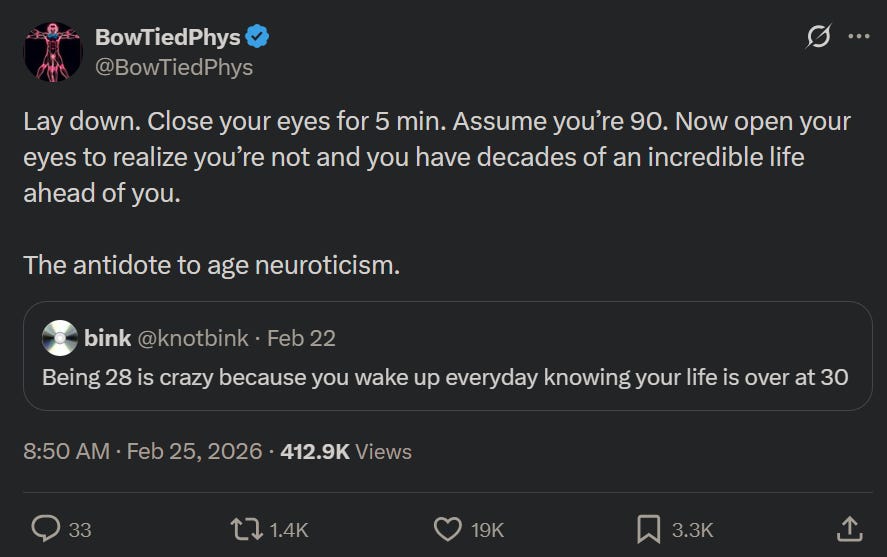
Solution #2: Your story is your competitive advantage
Every moment in your life up to this point has molded you into who you are today. No time is “wasted.”
To figure out what you are, you have to figure out what you’re not. And figuring out what you’re not requires crossing bridges to places you never intended to go.
Years spent as a degenerate? Perfect. Write about them. Send the ladder down. People desperately want to know how someone dug themselves out of the same hole they’re currently in. Your failure synthesized into intelligence has an audience of thousands.
Punted a few biz opportunities? If you are a sentient human, you took something away from it. Now continue creating & redefining. Hold all else equal. Test again. Keep iterating. Life is a pattern recognition game. And it’s best played as a closed loop control system.
Invested years in the wrong relationship? You got more from that than a four-year degree in human psychology ever could have given you.
Come to view your past in peace. Recognize that without these experiences, the path forward doesn’t exist in the ideal form.
Solution #3: Log off & go upstream before you react
Social media has made 30 feel like a deadline. Hustle culture made 40 the new 30, and then AI anxiety made 12 months feel like a window that’s already closing.
*points to Charlie Munger’s most useful heuristic* → “Show me the incentive, I’ll show you the outcome”
Apply this to every piece of age-anxiety content you encounter. Before you internalize it, ask:
Would this source have anything to gain by proposing the opposite narrative? (“Invert. Always invert.”)
What does this person benefit from by pushing this particular fear?
The answer is always the same. Manufactured urgency is a business model. Fear of falling behind is infinitely monetizable. The algorithm serves you the content that keeps you most agitated: agitation drives engagement & engagement drives revenue. Simple.
Log off with intent. The digital world has real value, but there is real skill for knowing when you’ve flown too close to the sun.
Solution #4: Slow time down by building new side quests
To subjectively slow time & make your 20s/30s feel as long as your teens, you need to maintain the neurological conditions of a beginner.
Build adjacent territories: Pick up BJJ. Study a second language. Take on a new writing project. Build the ecomm biz. The goal is deliberately inducing the state that produces dense memory encoding and the subjective experience of time expanding.
Neuroplasticity declines with routine but you reserve the right to deny the time accelerator that is monotony at any point.
Solution #5: Engage with a wide range of ages
The echo chamber of same-age peers reinforces the illusion that everyone is on the same timeline and that the milestones are universal. Far from the truth.
Spend meaningful time with people in their 50s and 60s who are doing interesting things. Spend time with people in their 20s who are just starting out. The former dissolves the urgency of the arbitrary milestones. The latter shows you what raw beginnings actually look like from the outside.
Both will give you perspective that your peer group structurally can’t.
Solution #6: One barometer to rule them all
Here’s the simplest mental model I can give you for navigating the digital world without burning neurons in the comparison game: it’s last week you vs. this week you.
An annualized version I find effective: is my life better this year than last year? Not in every dimension because that’s not how life works. But in the trajectory. In the vector sum.
If yes: you’re winning. You’re getting what you want out of life, which is the only honest definition of happiness.
If no: get precise by going deeper. “I’m behind” is too vague to act on. Get specific about what you actually want. You’ll be surprised how little you’ve actually considered this until you whip out the ol’ pen & paper. Get specific about what it costs. Then pay that price.
Solution #7: Narrow your scope
All anxiety is predicated on living in the future & evading what is now.
Goals are the mountain that appear unattainable to scale. Systems are the steps that look laughably simple.
The mountain is just many of those tiny steps.
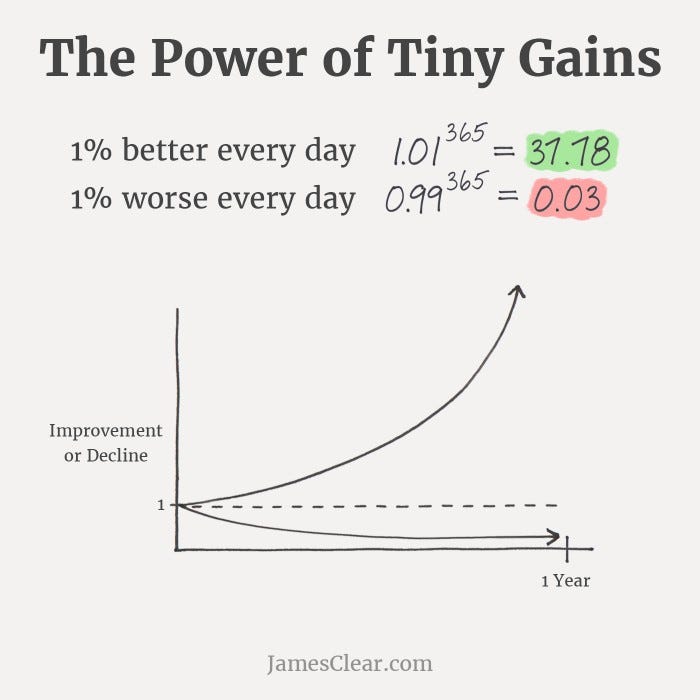
This is why goals underperform, resolutions rarely stick, and systems remain king.
Focus: narrow your scope → more proximity to the task → greater presence → more control → clearer thinking → greater fulfillment → incrementally closer to self-actualization. (You’ll sleep better too.)

There’s a single thread running through all seven solutions: perspective.
The physical reality remains unchanged in the near term, but you can bend the reality of what lies ahead to your own will by crafting the very lens you wish to view it through.
The age anxiety epidemic is real. The psychological suffering it produces is real. But the cure exists and all it starts with is an improved mindset & a frame shift.
Accept that you have time, but move with calm urgency. And remember: you are never too late.
Head down, friends. The best is yet to come.
- Phys