


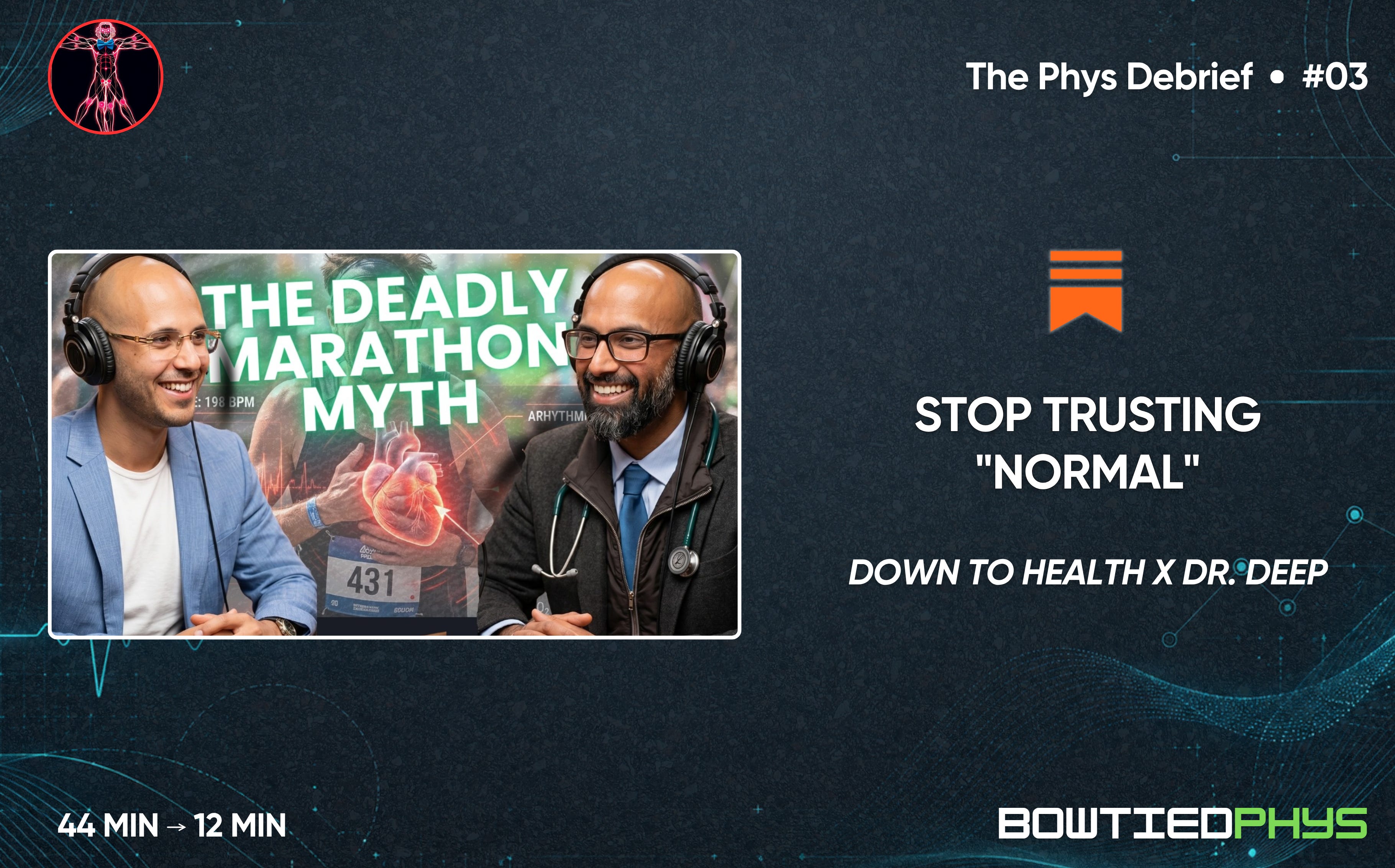
The Phys Debrief · #03
Practical takeaways & the latest research from the health space’s most valuable long-form content, without the rest.
Centralized medicine has defaulted to handing you a reference range and calling it a day. Dr. Deep takes a refreshingly different approach.
His thesis is simple: the 40—50 decade is when entropy starts winning and the people who thrive through it are the clear thinkers who stop outsourcing their health to a system built for averages.
An rising voice in the longevity space, Deep thinks in mental models, ratios, & root causes, rather than single value biomarkers. So you can imagine why we chose to debrief this one.
Contents:
In 1 Sentence
In 250 Words
Practical Takeaways
Episode Blueprint
Where to Listen & Watch
In One Sentence
Midlife is a high-entropy inflection point, and surviving it well means abandoning population-based “normal” ranges and single-metric thinking in favor of individualized targets, root-cause anti-inflammatory living, and data used to investigate.
In 250 Words
Dr. Deep’s organizing idea: modern medicine optimizes for the average patient, but the average patient is getting sicker so “normal” is a moving target you shouldn’t aim at. 70% of Americans are overweight or obese. 60% are diabetic or pre-diabetic. A testosterone of 300 & a testosterone of 900 are both “normal” and represent completely different lives. His clinic builds tighter, individualized ranges instead.
The episode’s most useful reframes are diagnostic. High cholesterol alone doesn’t cause heart attacks — you also need damaged vascular endothelium, which comes from high blood pressure, smoking, diabetes, or inflammation. Low VO2 max carries a far larger mortality signal than a modestly elevated LDL. A lean marathoner can still be insulin-resistant and over-trained into chronic high cortisol because muscle is the glucose sink and cardio alone doesn’t build it. Fasting insulin is a leading indicator of diabetes. A1c is a lagging one that fires after damage is done.
“Inflammaging” is chronic low-grade inflammation from poor sleep, stress, visceral fat, and constant sympathetic activation that smolders until it ignites real disease. The fix is root-cause, not symptom suppression.
Practically: Pair carbs with protein and fat. Run a CGM for a month to learn your responses. Use the 3-2-1 sleep rule (no food 3h before bed, no screens at 2h, limit fluids at 1h). Use wearables to build body literacy, then stop letting them override how you actually feel.
Practical Takeaways
Mental Models (first principles)
Treat “normal” as a warning (not the objective:) Population reference ranges drift with the population’s health, but the population is getting sicker. A result inside the “normal” band can still be far from optimal. Ask for individualized targets.
Think in ratios and systems (not single numbers): Sex hormones especially only make sense in relation to each other (testosterone to estrogen, plus SHBG), and “biological age” of one organ is meaningless if another is failing. Stop optimizing one metric in isolation.
Use data as a prompt to investigate: A bad biological-age score or a high HRV-variance reading is a signal to go check the engine. Beware false precision — obsessing over two-beat HRV swings isn’t useful.
Cardiometabolic Screening
Get apoB measured, not just cholesterol: apoB counts the number of atherogenic particles (”cars and trucks on the highway”). Standard cholesterol counts how full each particle is, which matters less. Particle number is what drives the traffic-jam event.
Track fasting insulin as your early-warning light: Elevated fasting insulin means your pancreas is already working overtime — a leading indicator of impending diabetes. Hemoglobin A1c is a lagging indicator that confirms damage already done. Check insulin to get ahead of it.
Don’t let leanness or fitness reassure you: A great VO2 max can coexist with low muscle mass, chronic hypercortisolemia, hyperglycemia, & insulin resistance. “Lean” is not “metabolically healthy.” Quantify the hidden risks instead of eyeballing them.
Weigh VO2 max heavily in your heart-risk picture: Low cardiorespiratory fitness carries a mortality hazard ratio in the same range as (or larger than) smoking or diabetes, far above a modestly elevated LDL. Building aerobic capacity is one of the highest-leverage moves available.
Muscle & Metabolic Flexibility
Build muscle as a glucose sink: Muscle pulls blood sugar into productive storage instead of letting it glycate and damage tissue. Cardio alone doesn’t do this. If you only train endurance, you’re leaving a major metabolic lever untouched.
Mind muscle loss on GLP-1s: Rapid weight loss on GLP-1 / weight-loss drugs can strip muscle along with fat, which may undercut the same glucose-sink protection — a reason to pair these drugs with resistance training and protein.
Avoid naked carbs: Pair carbohydrates with protein and fat to blunt glucose spikes. Run a CGM for at least a month to learn your personal responses (including how poor sleep and acute stress spike glucose in real time) then apply the lesson without wearing it forever.
Inflammaging & Recovery
Hunt the root cause of inflammation: Smoldering low-grade inflammation from poor sleep, chronic stress, visceral fat, or autoimmune conditions is the kindling for most age-related disease. Suppressing inflammation (i.e. via a hyperbaric chamber) while leaving the cause in place is a half-measure.
Shift the autonomic balance toward vagal tone: Modern life keeps you in chronic sympathetic activation (blue light, doom-scrolling, stress), which feeds inflammation. The highest-yield move is removing the offending stimulus without adding a hack.
Run the 3-2-1 sleep rule: No food 3 hours before bed, no screens 2 hours before, limit fluids 1 hour before. Dr. Deep calls this the hidden unlock for the over-stimulated executive archetype and screens at the 2-hour mark are the hardest and most important one to hold.
Tools & Diagnostics (how to actually use them)
CGM — worth a month, not a lifetime: Available over the counter now. Use it to build intuition about your glucose responses, then stop before it makes you neurotic.
Full-body MRI — bullish, with a caveat: Prices are collapsing (Ezra around $500, headed toward DEXA-like ubiquity). The real prerequisite is a clinician who has prepped you for incidental findings so a benign spot doesn’t terrify you. Data in the wrong hands is “a monkey with a machine gun.”
Wearables — let how you feel win: Sleep trackers and Whoop are useful for a month or so to learn your patterns, but they fill in gaps and estimate (the Apple Watch VO2 max formula reportedly traces to one tiny old study). When the tracker and your felt experience disagree, trust your body. Letting the device dictate how you feel is “orthosomnia.”
Episode Blueprint
[00:00:00–00:08:10] Intro: Dr. Deep & the Velocity Health Model
Key Points
The guest is Dr. Sandeep “Deep” Palakodeti, MD/MPH, founder of Velocity Health and author of The Ultimate Asset. The MD/MPH combination gives him both the population bird’s-eye view and the individual clinical lens, which is the source of his core critique.
His framing of the system: physicians become “widgets in a machine” with ~10 minutes per patient, structurally unable to do prevention or deep individualized care.
Velocity is pitched as a digitally native concierge precision-medicine clinic, licensed in all 50 states — “your doc in your pocket” for high performers who travel and want quarterly 90-minute visits rather than rushed appointments.
The macro case for urgency: ~70% of Americans overweight or obese, ~60% diabetic or pre-diabetic, with cancer and neurodegenerative disease climbing. “What we’re doing is obviously not working.”
“You have to start from first principles thinking & blow it completely up.”
— Dr. Sandeep Palakodeti
[00:08:10–00:12:55] The Concierge Awakening & the “Not-Normal” Patient
Key Points
Rapid hair thinning in host’s late 20s sent him through urologists and endocrinologists with no answers, until a cash-pay clinic caught a lifelong-missed Hashimoto’s, diagnosed low testosterone, and walked him through hCG, fertility preservation, and vitamin D in a single unhurried visit.
High performers who can model a portfolio for decades but have no system for their own health, and who don’t fit the “normal patient” mold a 10-minute visit assumes.
Fringe communities (i.e. bodybuilding forums) often run 10–20 years ahead of mainstream medicine on practical protocols.
“It’s really difficult to find doctors that understand that you’re not the normal patient.”
— Dr. Ilon Choai (paraphrased)
[00:12:55–00:16:37] BS or Not: Slower Metabolism & Broken Lab Ranges
Key Points
“Midlife means a slower metabolism no matter what” — BS. Elite marathon and endurance performance often peaks later than sprint sports because mitochondrial biogenesis takes years to build. Midlife can be an inflection point toward peak health.
The 40–50 decade is real “peak entropy”. Things break down faster and require more intentional effort to hold together.
Lab reference ranges are population-derived so they drift as the population changes. Median testosterone for a 40-year-old male was ~700 forty years ago; it’s closer to ~400 now, yet the “normal” band widened to accommodate the decline.
A T of 280–300 and a T of 900 are both “normal” and are completely different lives.
“That’s just two standard deviations of the current population. That’s not what it should be. That’s not optimal.”
— Dr. Ilon Choai
[00:16:37–00:18:30] Does High Cholesterol Actually Cause Heart Disease?
Key Points
High cholesterol is a single input. You need both atherogenic particles and damaged vascular endothelium for the heart-attack cascade to start.
Endothelial damage comes primarily four ways:
High blood pressure
Smoking
Diabetes
Chronic, low-grade inflammation
On relative weighting: low VO2 max carries a ~4x hazard for cardiac events vs. ~1.2x for elevated LDL-C. Control the bigger levers and there’s likely a healthy middle range for cholesterol rather than a “lower is always better at all costs” mandate.
A coronary calcium score of 0 in a young person can be falsely reassuring — soft plaque hasn’t had time to calcify into the hard plaque the scan detects.
Studies referenced
Association of Cardiorespiratory Fitness With Long-Term Mortality Among Adults Undergoing Exercise Treadmill Testing (JAMA Network Open, 2018; Mandsager et al.) — In 122,007 patients, low cardiorespiratory fitness vs. elite carried an adjusted all-cause-mortality hazard ratio of ~5.0, exceeding smoking, diabetes, and coronary artery disease, with no observed upper limit of benefit.
[00:18:30–00:21:26] The Marathon Runner Heart-Attack Paradox
Key Points
A 50 yr old patient in good shape who ran a half-marathon had a heart attack anyway.
Two failures stacked: 1) too little muscle (muscle = glucose sink that keeps blood sugar from glycating & damaging tissue) and over-training into chronic high cortisol & chronic hyperglycemia → producing insulin resistance.
“Just because you’re lean doesn’t mean you’re healthy.” Metabolic health has many independent levers. You can be excellent on a handful and in the dumpster on the rest. Eyeballing someone tells you almost nothing.
Concern flagged for GLP-1 / weight-loss-drug users: rapid loss of weight can mean loss of muscle, potentially eroding that same glucose-sink protection.
“Just because you’re lean doesn’t mean that you’re healthy.”
— Dr. Sandeep Palakodeti
[00:21:26–00:24:04] Is “Biological Age” Just a Gimmick?
Key Points
The absolute number is largely unproven. No one has run the multi-decade follow-up to confirm a “15 years younger” score means you actually live longer.
Directionally useful, though. Most tests amalgamate many data points so a sudden jump after a bad 6 months is a signal to go investigate.
Per-organ “ages” are misleading when siloed. A 22-year-old immune system is irrelevant if your cardiac age is 74. The body is one system.
The space loves data, but should temper it with humility about false precision. “Everyone’s neurotic age is very high.”
“I think it’s just signals that are telling us that we need to check the engine somewhere. So go do that.”
— Dr. Sandeep Palakodeti
[00:24:04–00:26:39] Explain It to My Mom: apoB & Fasting Insulin
Key Points
apoB analogy: Arteries are highways. A heart attack is a crash/traffic jam. What causes jams is the number of cars and trucks (not how many passengers are inside). apoB counts vehicles (particles). Cholesterol counts passengers (cargo), which matters far less.
Fasting insulin analogy: When you eat too much sugar it sits in the blood and damages vessels. Insulin pushes it into safe storage. Elevated fasting insulin means the pancreas is working overtime — a leading indicator of impending diabetes.
Hemoglobin A1c is a lagging indicator: By the time it’s high, the damage is already underway. Checking fasting insulin gets you in front of the disease process.
“Checking fasting insulin is a way for us to get in front of the disease process way ahead of it.”
— Dr. Sandeep Palakodeti
[00:26:39–00:28:14] What Is “Inflammaging”?
Key Points
Inflammaging = chronic low-grade inflammation → the “little smoldering fires” all over the body. Driven by poor sleep, high stress, autoimmune conditions, & excess visceral fat.
Those baseline fires are what let other disease processes catch and spread. Put them out and it’s much harder for downstream disease to take hold.
On suppressing inflammation without fixing the cause: Always pursue the root cause.
“Even if we’re healthy in a lot of ways, those fires eventually cause the forest fire.”
— Dr. Sandeep Palakodeti
[00:28:14–00:30:01] Vagal Tone & the 3-2-1 Sleep Rule
Key Points
The body runs on a balance between sympathetic activation and parasympathetic “rest and digest.” Modern life (blue light to midnight, chronic stress, doom-scrolling) keeps us over-activated, which drives inflammation and heart disease.
The first move to raise vagal tone is to remove the offending stimulus, not to add a gadget or supplement.
The 3-2-1 sleep rule:
3 hours before bed = Last meal
2 hours before bed = Screens off
1 hour before = Fluids limited 1 hour before
“The best thing is remove the offending stimulus.”
— Dr. Sandeep Palakodeti
[00:30:01–00:37:01] The Health-Trends Tier List: CGMs, MRIs & Wearables
Key Points
Metabolic flexibility — S tier. The single biggest thing. Avoid naked carbs. Pair carbs with protein and fat. Consider a CGM for at least a month.
Stem cells / PRP — A tier on promise. Still early on data. Bullish long-term but not yet proven.
CGM — A tier for short-term use. Great for learning how sleep and stress move your glucose, available OTC, but easy to get neurotic about.
Full-body MRI — A-to-B tier. Bullish as prices crater (Ezra ~$500), but only valuable with a clinician who preps you for incidental findings. The “find stuff we don’t know what to do with” objection is really a failure of the doctor-patient relationship.
Wearables / sleep trackers — Useful for ~a month to build body literacy, then optional. They estimate and fill gaps. How you feel wins. Letting the tracker dictate your mood is “orthosomnia.”
“If it’s discordant, how you feel should win, not the other way around.”
— Dr. Sandeep Palakodeti
[00:37:01–00:39:46] Your Evolutionary Duty in Midlife
Key Points
The closing reframe: Why do humans live well past reproductive age when most male animals don’t? The elephant/wolf analogy — elder “institutional knowledge” (where the distant watering hole is) protects the whole tribe.
The leaders of consequence (CEOs, governors, legislators) cluster in the 50–65 decade, exactly when peak biological entropy sets in. Failing to fight that decline systematically is, in his framing, a failure of duty to the people who depend on your knowledge.
Whether you DIY or hire a team, the mandate is the same: Arm yourself with real information and build a system around your health instead of waiting for the system to fail you.
“It is our evolutionary duty to pass along the wisdom and knowledge that we attain throughout our entire life in this middle-age decade.”
— Dr. Sandeep Palakodeti
Listen & Watch
YouTube
Spotify
Apple Podcasts: Down to Health
Where to find Dr. Deep:
Velocity Health: velocityhealthclinic.com
Book: The Ultimate Asset
His podcast: The Ultimate Asset
We’re pushing out way more content on our paid side (some new n=1 experiments + a few new protocols you’re not going to want to miss).
All of which is made possible by you guys here on Substack. And we couldn’t be more grateful for the continued support.
More to come in the next few weeks. Stay after it until then.
Your friend,
Phys
I've felt this for some time but it's nice to hear someone say it.
My daughter has been in the lower percentile for weight since forever. My initial reaction was good, because normal is fat.
Thank you.